

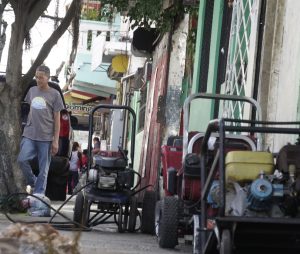
Negligence of city governments has allowed businesses and individuals to cut into sidewalk space in the cities. A report in El Dia describes sidewalks in Santo Domingo as “an obstacle course” that pedestrians have to deal with every day. The newspaper explains that the situation is so common that city residents see it as normal. Improvised food vendors, garbage tanks, ramps to facilitate the entry of vehicles into buildings, repair shops, potable water bottle stands, emergency power plants all take up city sidewalk space.
The sidewalk situation is critical because the institutions are not doing their job, says Marina Valera, professor of environmental education at the Pedro Henríquez Ureña National University (UNPHU). She complained that usually city governments point to Haitians as violators, but not to the rich. She said that if a person who is obstructing public space is wealthy, they seem to have green light to violate the public space.
Cristóbal Valdez, former director of Urban Planning at the National District City Government (ADN), attributed responsibility to city governments. He said city regulations were only met in the Trujillo Era when two meters of sidewalk space was the norm. He explained that in 1998 a resolution established three meters for the Polígono Central and depending on the construction, up to six and ten meters. “In the following decades, this has been disrespected,” said the expert. He said in Santiago, Mayor Abel Martínez has also faced the same situation.
Valdez said that for some time now, city governments have turned “a blind eye” to the application of regulations. He said this has led to some brutal violations of the rules by developers who he says do what is best for them.
Read more in Spanish:
El Dia
20 January 2020