

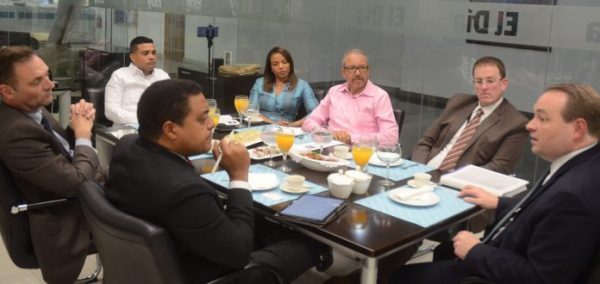
The geographical location of the Dominican Republic in the center of the Americas works against the country when it comes to the scourge of drug trafficking, observed Patrick Ventrell. He is the director of the Office for Western Hemisphere Programs of the Bureau of International Narcotics and Law Enforcement Affairs, US Department of State. He made the remark in an interview with El Día during a three-day official visit to the Dominican Republic last week.
In the interview with El Dia, Ventrell addressed the country’s vulnerability by sea and the increasing use of freight containers to ship drugs to the DR for later transshipment. He said improved maritime security is needed and more rigorous inspection of the containers arriving from abroad. He urged the Dominican Congress to pass the Extinction of Ownership Bill to divest the drug traffickers of wealth accumulated in the country.
“We are trying to work with the authorities and the companies that operate here to intensify the inspection of the containers, where the threat of drug trafficking continues to grow,” Ventrell said.
He stressed the importance of Congress passing the Extinction of Ownership Bill that is awaiting action in the Senate. “It is important to have a domain extinction capacity that works between both countries.” He said the US does not want drug traffickers “to think that they can go back to living comfortably after being convicted. We must take away their resources and invest them in the state.”
The US official said that in addition to drug trafficking, another concern for the White House is money laundering because the money flows in the region are significant.
Ventrell reiterated that because of the economic power of drug traffickers, combating this scourge requires more effort and cooperation between financial intelligence units, prosecutors and police. “Criminals are using new methods every day, both in the distribution and in the movement of illicit money. Our challenge as a government is to try to be more agile and innovative than they are,” he said.
He added that in terms of innovation, they also observe the movement of illicit money from drug trafficking through bitcoin and other electronic methods to provide new technologies to combat them. He said that because of the amounts of money they handle, drug traffickers will seek ways to permeate the judicial system and its actors, so they must have judges and prosecutors with higher capacities to handle complex cases.
Ventrell said the Dominican Republic is in a strategic area for the movement of many things, saying he has faith in the shared responsibility of both nations. He told El Dia journalists that several days ago, the office he heads intensified relations with the Bahamas and Turks and Caicos Islands, in addition to making approaches to the Haitian government.
The high-ranking anti-narcotics officer did not rule out the future possibility of the United States implementing plans like those of Colombia and Merida in the Caribbean, assuring that the US Congress has allocated resources. The Plan Colombia is a bilateral agreement signed between Colombia and the United States in 1999, which had three specific objectives: to generate social and economic revitalization, to end the armed conflict in Colombia and to create an anti-narcotics strategy.
In 2008, Mexico and the United States signed the agreement on the Merida Initiative to optimize the capacities of police institutions, judicial processes and border security between both countries and Central America.
Read more in Spanish:
El Dia
17 February 2020