

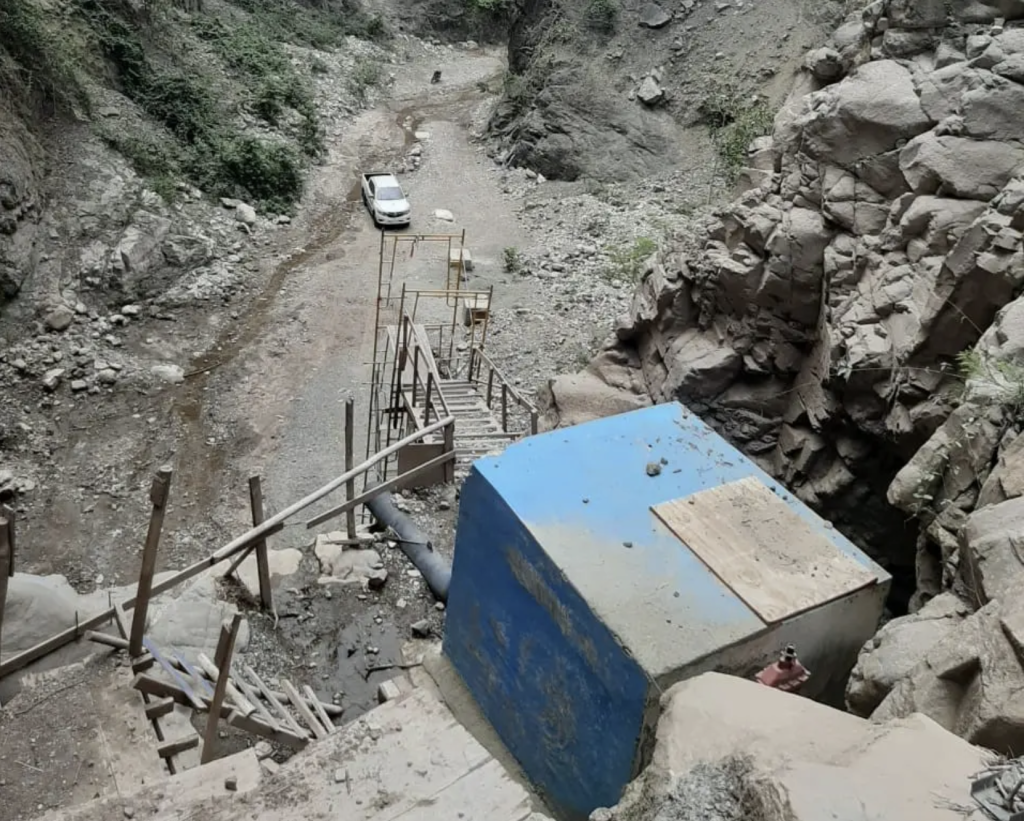
The Specialized Prosecutor’s Office for the Defense of the Environment (Proedemaren) ordered the construction work on the Estebanía-Las Charcas Multiple Aqueduct in Azua to be halted until the investigations on the permit for its execution in an ecologically vulnerable zone are concluded.
The head of Proedemaren, Francisco Contreras said the construction works have dried up the Grande River. The works are carried out by the National Institute of Drinking Water and Sewage (Inapa).
Contreras said that on the 19th of May 2022, a team from the Public Prosecutor’s Office went to the site accompanied by technicians from the Academy of Sciences and the Environmental Commission of the Autonomous University of Santo Domingo (UASD) to carry out technical investigations and information gathering.
They indicated that the supervisor of the work, Freddy Almonte, told them that the project is being developed within the Francisco Alberto Caamaño National Park, which constitutes a serious violation of the Protected Areas Law 202-04, Biodiversity Law 333-15, and Environment Law 64-00.
The prosecutors contacted the supervisor of the work, Freddy Almonte, who argued that “they (the builders) did not have the environmental permits in the office.”
By means of bailiff act number 661-2022, notified to Eudis Abigail Cordero Heredia, provincial director of Inapa, the Proedemaren said that notification No. 00137, issued by the court prosecutor Eusevio Corcino Alcántara orders the paralyzing of the construction.
The director of INAPA, Wellington Arnaud defended the construction saying the construction did not cause the damage to the river system.
Arnaud said on Tuesday, 24 May that for the construction of the Estebanía-Las Charcas Multiple Aqueduct, in Azua, “not a drop of water is being taken from the Salto Río Grande.
He explained the Estebanía Multiple Aqueduct is an intake project, a 70 LPS treatment plant and lines that will feed 3 reservoirs. He said it is intended to bring drinking water to more than 16,000 inhabitants of Estebanía and Las Charcas. It will also supply Cañada Cimarrona, another community in the area, which will benefit more than 500 inhabitants.
INAPA said that the lack of water in El Salto is due to the many irregular connections made by others. “Irregular intakes upstream decreased the flow to such a low level that it affects the environment and access to drinking water,” he explained. He said local residents have installed more than 30 pipes and hoses to irrigate their crops. He also attributed the low water supply to drought and climate change.
He said that INAPA is seeking to solve the problem by installing an intake that will result in less environmental impact and less water flow.
25 May 2022