

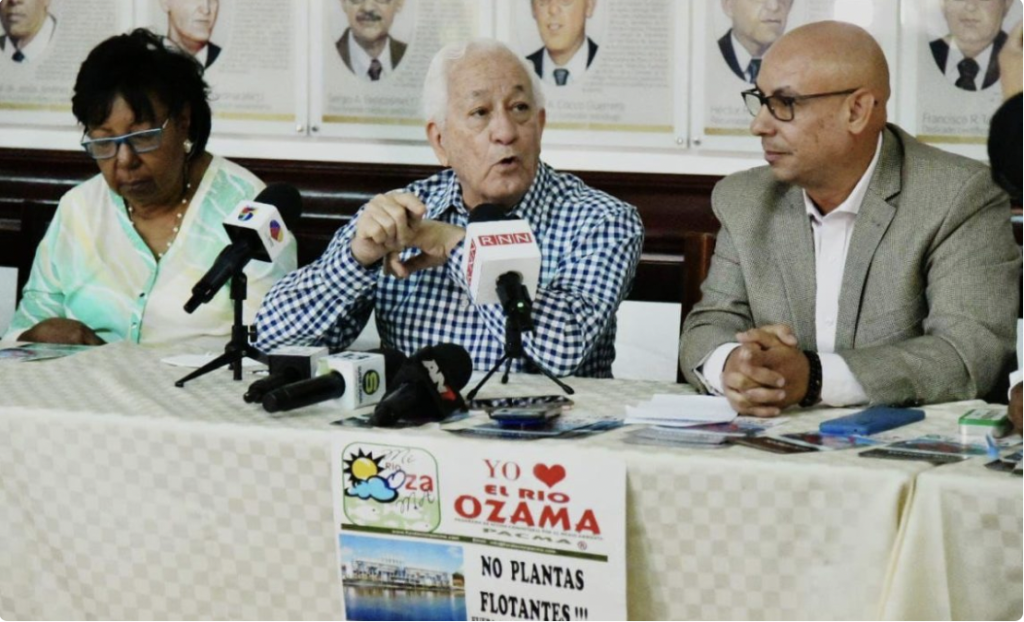
Several environmental and community organizations have asked the Academy of Sciences of the Dominican Republic to join the multidisciplinary team that the Ministry of Public Health will form to carry out an investigation to establish the magnitude of the damages to health caused by the power generation barges operating in the Ozama River. The barges are owned and operated by Seaboard Transcontinental. The president and coordinator of the Environment and Natural Resources Commission of the Academy of Sciences, Luis Schecker Ortiz and Felicita Heredia said they are open to the request of the concerned civic society entities.
The organizations that oppose the operation of the barges are: Programa de Acción Comunitaria por el Medio Ambiente (PACMA), the Comisión Ambiental de Esperanza por el Ozama, the Red Nacional de Resistencia y por la Remediación del Daño Ambiental, the Instituto de Abogados para la Protección del Medio Ambiente (Insaproma), the Central de Trabajadores Unificados (CTU) and the Comité Nacional de Lucha Contra el Cambio Climático.
Schecker Ortiz says that the Academy of Sciences has always been a supporter of actions to protect the environment and natural resources, particularly water. Schecker Ortiz announced the Academy of Sciences would participate in the needed studies. He called the continued operation of the barges in the Ozama River “an anomalous situation.”
“We do not know about the authorization or the right these companies uphold, but no right is above the Constitution of the Republic. If an ill-gotten right is exercised, then the Constitution of the Republic imposes that regulations be enforced,” he said.
Environmental organizations delivered to the Academy of Sciences a study prepared by scientist Rye Howard, of the Environmental Law Alliance Worldwide (ELAW), which reveals that thermal, air, noise and vibration pollution from these barges affect the health of the inhabitants of sectors in the area, such as: Calero, Pueblo Nuevo and Maquiteria in Villa Duarte; Los Guandules, Las Cañitas, Santa Barbara, Villa Francisca, La Barquita and the Colonial City.
The report establishes the presence of air pollutants in the area where the barges operate, such as nitrogen oxides, whose exposure to NO2, which is the main pollutant, causes irritation of the respiratory tract, bronchoconstriction and difficulty in breathing, asthma attacks and increases the risk of respiratory infections.
The report also indicates that emissions of sulfur oxides form pollutants that alter the development of lung function in children and contribute to the deterioration of lung function in adults; and furthermore, cause and aggravate asthma and cardiovascular disease.
“This study reveals that these power plants are polluting 15 times more or above what the standards stipulate for a generator of this same capacity. And they are causing asthma, heart disease, skin disease and insomnia, nervous diseases from the vibrations. Due to the prolonged duration of the 32-year old plants, it is necessary to examine the victims in the area”, said Euren Cuevas, executive director of Insaproma.
Regarding noise and vibration, the document states that “the presence of significant noise and vibration pollution is a source of discomfort and possibly a source of serious health problems for neighboring communities.”
The study notes: “High noise levels can cause hearing loss, especially over prolonged periods. However, beyond hearing loss, prolonged exposure to even moderate noise levels causes a wide range of problems, from sleep disruption to impaired cognitive performance in children and cardiovascular disease.”
The report concludes: “Electricity-generating barges operating under marine standards for environmental impacts are not suitable for placement in dense communities such as Santo Domingo for extended periods.” Another of the report’s conclusions is that the use of HFO (fuel oil), the dirtiest of the petrol-based fuels, must cease completely.
The coalition of non-governmental organizations (NGOs) previously filed a petition with the Ministry of Public Health requesting an exhaustive medical investigation to establish the magnitude of the serious damage to health caused by these power generation barges owned by Seaboard Transcontinental located on the Ozama River. They requested the intervention of the Ministry of Public Health as the governing entity in matters of collective health.
Read more in Spanish:
N Digital
21 July 2022