

For the past month, there has been tension between the Dominican Republic and Haiti, its neighbor. For years, the bi-national table, the framework for binational discussions, has been dysfunctional given the lack of governance in Haiti. After the death of Jovenel Moise, the question is who talks for Haiti, Ariel Henry and his ministers, or the gang leaders.
The most recent major issue is the re-start of the construction of a waterworks to divert the flow of the waters of the Dajabon/Masacre River as it passes through Haiti. At the request of the Dominican government, the work had been stopped during the Moise government, only to be resumed after his death.
The Dominican government has requested a stop to the seemingly makeshift construction until technical studies are carried out. The Haiti government continues to back the construction.
Foreign Minister Roberto Alvarez has said technicians have alerted a situation of intense rainfall could cause a major catastrophe, affecting farms in Haiti and the Dominican Republic and the Codevi manufacturing center that is close to the point where the waterwork structure is under construction and employs around 19,000 Haitians.
The Dominican government argues that the construction began without previous consultations and does not have adequate studies.
Foreign Minister Roberto Alvarez has carried the Dominican position, explaining recently to the Dominican Senate and more recently to the Organization of American States forum. Alvarez has said that the position of the Haitian government to allow the construction could lead to an environmental and human catastrophe.
The Haitian government insists it is in its perfect right to use the river’s waters as it flows through Haiti. It argues the Dominican government has built canals over rivers in the Dominican Republic.
On 13 September, the Dominican government called a shutdown to the official air, land and sea border gateways between the Dominican Republic and Haiti. The shutdown is at a high cost to the Dominican Republic, a major exporter of goods to Haiti. The shutdown has affected freight trucks that deliver inputs for the Haitian free zones, the largest employers in Haiti.
As a result, contraband reached new highs, with a higher cost in goods for the Haitian people. Furthermore, less Haitians would cross over to receive free medical services at Dominican hospitals. The closure also affects thousands of Haitians who travel to the Dominican Republic to fly to their ultimate destinations around the world.
In his remarks at the OAS last week, Foreign Minister Alvarez described the Haitian government backing of the construction of the waterwork as “irrational and unacceptable.” He asked for OAS experts and members of the Inter-American Bank for Development (IABD) to come to the Dominican Republic and provide guidance and assistance to the feasibility of the waterworks.
Alvarez has stressed that the canal would threaten the lands around the CODEVI Free Zone Industrial Park and its 19,000 employees, as well as 880 hectares of surrounding lands in the Dominican Republic as well as 628 hectares in Haiti, affecting nearly 400 farmers in both countries.
Later, the Secretary General of the OAS suggested a series of meetings to discuss the canal’s construction and to send a technical mission to evaluate the Haitian project. Luis Almagro made these proposals after the intervention by Dominican Foreign Minister Roberto Alvarez.
Eventually, the National Border Security Council authorized the partial opening of the border for trade and the binational markets, but only for foot traffic and within the area of the market. Those crossing are to be subject to biometric registration. Previously, Haitians could enter, and there were no controls on who entered and where they went. Most people in Haiti do not have legal documentation.
The government of Haiti protested the measure and said it would not open its gates unless the past free entry of people and goods was restored. The Haitians kept the doors closed for the first week.
By the weekend, the Haitian side was allowing the crossing of Haitians, reportedly so they could remove their merchandise at the binational marketplace. Haitian merchants are big losers. Several sustained losses when a yet unexplained arson of two dozen stalls of Haitian vendors was burned on the same day the market would have reopened. The vendors, mostly women, were able to see what was left of their stalls after the fire. Vandalism is the standard mode of operation in Haiti.
“It is not a secret to anyone that they (Haitian merchants) have most of the cubicles on this side full of merchandise and they told us that their merchandise is rotting, that they are going to be damaged, so there is a need to speed up the process, that things begin to flow and everything is normalized despite certain differences, they have told us,” said Abigail Bueno, president of the Dajabón Merchants Association, commented to Diario Libre.
Haitians had boycotted the commercial corridors opened by Presidential decree in Dajabon, Elias Piña, Jimani, and Pedernales. Apparently, the Haitian authorities seem to be miffed at the partial opening of the frontier, and this is their way of showing it. Haitian industrialists also call for Haiti to become more self-sufficient.
Luma Demitrius, the mayor of Dajabon’s neighbor across the river, Juana Mendez (Ouanaminthe), told reporters from El Caribe that there need to be same clear rules for the re-opening of the gates between the two nations.
Noticias SIN reported that hundreds of merchants and buyers entered on Sunday to the Dajabon market day, reportedly to remove their inventories, but there were reports of some sales.
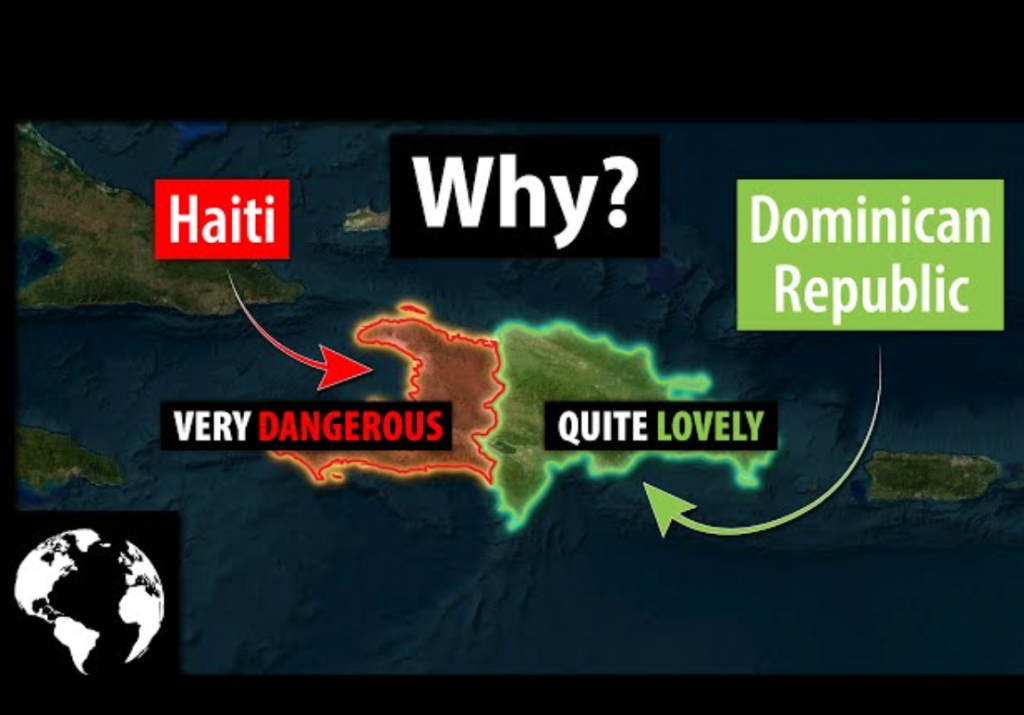
Geography by Geoff explains that H
Read more:
Diario Libre
Diario Libre
Diario Libre
Diario Libre
Diario Libre
El Dia
Noticias SIN
El Caribe
El Caribe
Listin Diario
Listin Diario
Acento
Minister Roberto Alvarez at the OAS
APNews
16 October 2023