

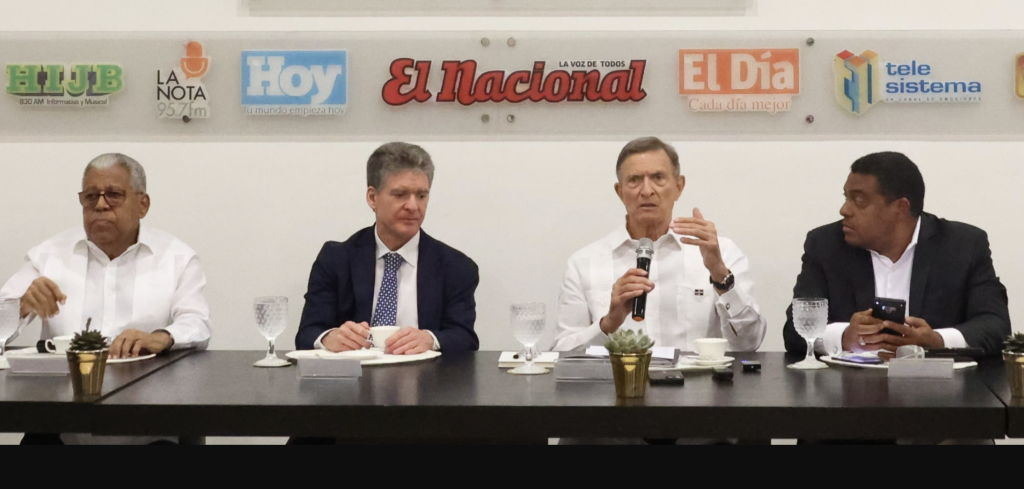
Foreign Relations Minister Roberto Alvarez stated in an interview on 13 March 2024 with the Corripio Media Group that the Dominican Republic cannot stop the deportation of foreigners illegally in its territory as requested by the United Nations (UN) in a recent statement.
“We contribute to the Haitian population in our country in a considerable way,” he said. He mentioned that 16% of the National Budget’s health allotments are for foreign nationals, mostly Haitians. He added that 36% of the maternity beds are used by Haitians. He said this is an astronomical figure that is increasing and is impossible to sustain.
He specified that, for this reason, the Dominican Republic has no alternative but to continue returning any person who is illegal to its country, respecting human rights and international standards.
Álvarez acknowledged that sometimes situations occur during deportation processes, which they try to correct. He said: “There is a desire and will of all authorities to comply with those regulations.”
The spokesman for the UN General Secretariat, Stéphane Dujarric, recently asked the Dominican Republic to “respect the human rights of Haitians who seek to improve their lives in other places” and avoid the “forced deportations of people to a country that is clearly insecure”.
In reality, many more foreign nationals enter from Haiti than those who are deported. The deportations are at a high cost to the Dominican Republic. There is no quantifying of the number of undocumented people that enter every day through the 391 km border between both countries that for the most part is not patrolled, or loosely patrolled.
Meanwhile, the US is taking measures to reduce the number of Haitians reaching US shores. The Biden administration plans to use the US base at Guantanamo Bay in Cuba to process and possibly repatriate Haitian migrants intercepted at sea in the event of a mass exodus to the United States as Haiti is gripped by chaos caused by gangs, revealed CNN, citing an American official, Wednesday 13 March 2024.
The same position has been established by Jamaica and The Bahamas, two countries that have strong policies in place to discourage Haitian migration.
Read more in Spanish:
El Dia
Hoy
El Caribe
Listin Diario
Le Nouvelliste
14 March 2024