

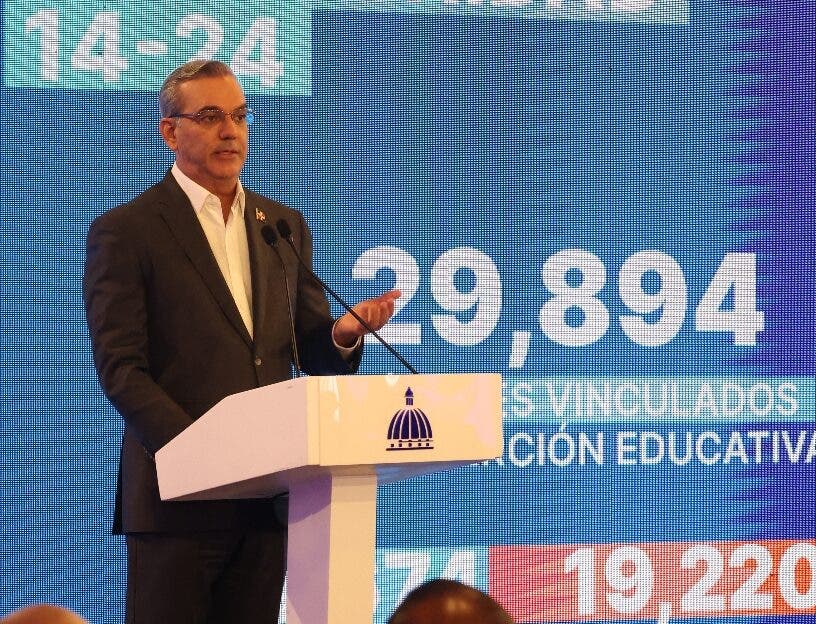
President Luis Abinader used the first half of the weekly La Semanal press meet to explain the effort to launch the Dominican Republic as a hub for manufacturing of semiconductors and microelectronics to benefit young people in the Dominican Republic. President Luis Abinader seeks to be reelected on 19 May 2024, and the majority vote in that election comes from young voters.
During the presentation, President Luis Abinader spoke of the important work carried out by the Las Americas Technology Institute (ITLA) that is now offering courses (6 months to two years) in semi-conductors and microelectronics, working closely with free zones as the country seeks to become a major exporter.
Omar Mendez Lluberes, rector of ITLA, spoke about 10-year plan to train semi-conductors manufacturing operators. The objective is to develop four-years specialists with basic training, and then move on to middle level specialists in six years, and in 10 years to have formed the advanced specialists. Graduates in the program start with wages of RD$70,000 a month.
The Abinader administration seeks to prepare the workforce to turn the Dominican Republic into an export hub for manufacturing of the semiconductors and microelectronics, essential to electronic devices today. The vision is to start now and so that in 10 years time the country may have the trained labor force to position the country as a leader in the Latin American and Caribbean region.
The Abinader administration is making available US$3 million for courses in semiconductor manufacturing to prepare for this new career for young people. 15 professors in mechatronics will be sent to be certified.
During La Semanal, President Abinader highlighted ITLA has 54,472 and 48,523 on scholarships. He said registrations for 2024 are estimated to be 9,000 nationwide. The President spoke of the ITLA centers in Santo Domingo and Santiago. There are also centers in Nagua, Moca, Pedernales and Monte Plata with plans to expand to Azua, San Francisco de Macorís, San Cristóbal, Villa Altagracia and Pedro Brand.
The demand for microelectronics and semiconductors has grown exponentially as the world increasingly relies on technology. Microelectronics and semiconductors are at the heart of many modern electronic devices. These tiny components play a vital role in our everyday lives, from smartphones to laptops to TVs and gaming consoles. These devices are essential for powering everything from smartphones to self-driving cars, and engineers continually discover new ways to miniaturize and improve them.
The current situation with microelectronics and semiconductors is serious. There is a worldwide shortage of these products, and it is having a major impact on the global economy.
Read more in Spanish:
La Semanal 15 April 2024
Hoy
Listin Diario
16 April 2024