

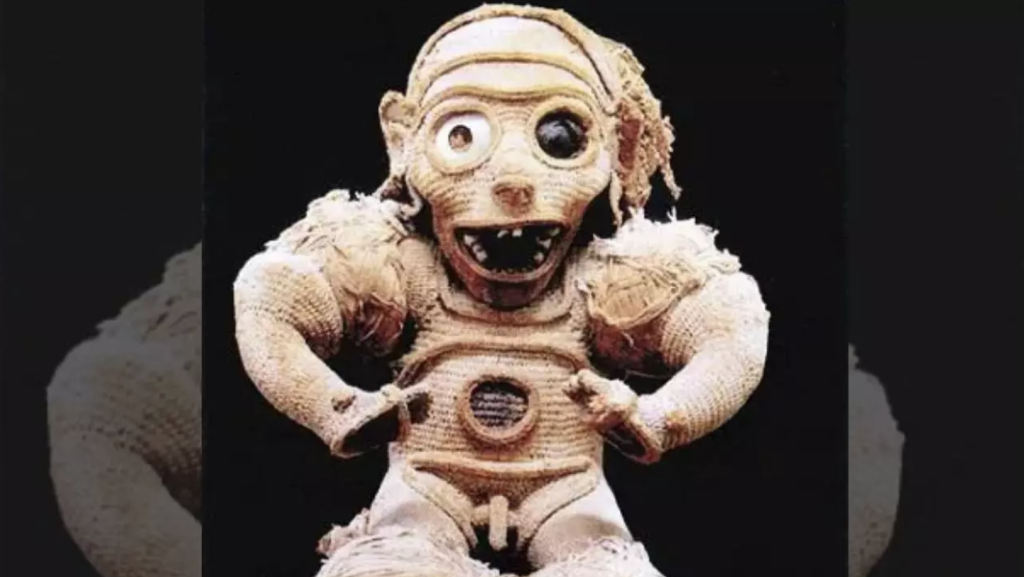
Historian Bernardo Vega has detailed the fascinating journey of a rare Taino cotton icon (cemi) that has survived since the 14th and 15th centuries and is set to be exhibited at the Museum of Dominican Man for six months next year. The artifact, currently housed at the University of Turin Museum, is the only one of its kind in the world.
Vega told Noticias SIN that the icon had made its way to Italy a long time ago but was misplaced as part of a collection of Peruvian artifacts.
Vega first stumbled upon a photograph of the cemi while conducting research at the British Museum in London. Intrigued by the image, he embarked on a years-long quest to track down the artifact’s whereabouts.
“In the late 19th Century, during the presidency of Ulises Heureaux, a cotton cemi containing a human skull was discovered in the Bahoruco Peninsula,” Vega told Noticias SIN. He noted that while chroniclers of the Indies often mentioned cotton cemis, most had been destroyed by the Inquisition in Spain. “This is the sole survivor, having been acquired by an Italian gentleman named Cambiaso. It was sketched by archaeologists who visited the country between 1901 and 1905, but then disappeared into Europe.”
Vega’s search led him to the Archaeological Institute of the University of Turin, where the cemi was initially misidentified as Peruvian. After undergoing X-ray analysis, its true origins and significance were confirmed. Radiocarbon dating has placed the creation of the cemi between 1441 and 1522, aligning it with the late period of Taino culture.
The historian emphasized the challenges he faced during his investigation, which involved countless letters, museum visits, and conversations with archaeologists. “Between finding the photograph in London and locating the piece in Italy, it took me about a year and a half of correspondence, letters, and research,” he explained.
The cotton cemi was initially sketched in Santo Domingo in the late 19th Century. Research by an Italian scholar uncovered a text by Cambiaso that pinpointed its discovery site in Enriquillo, a region formerly known as Petit Trou.
During that era, cemis were often considered demonic, leading to their destruction by local Catholic clergy. Despite these challenges, the artifact was eventually acquired by Admiral Juan Bautista Cambiaso in 1882. The cemi was initially drawn by two Italian archaeologists who visited between 1901 and 1905. The cemi would be transported to Europe with the country losing tract of it until Bernardo Vega began his investigations.
A detailed account of the cemi’s discovery was penned by the Italian admiral’s son Rodolfo D. Cambiaso in 1907 and is housed at the Smithsonian Institution. According to the document, the cemi was found in a cave near Petit Trou in today Pedernales by a hunter who mistakenly believed it to be a ghost and struck it with a machete.
Vega is a renowned Dominican economist who has been Governor of the Central Bank, Dominican ambassador to the United States, but throughout his prolific career as an award-winning historian of diverse topics.
Read more:
Noticias SIN
DR1 News
23 October 2024