

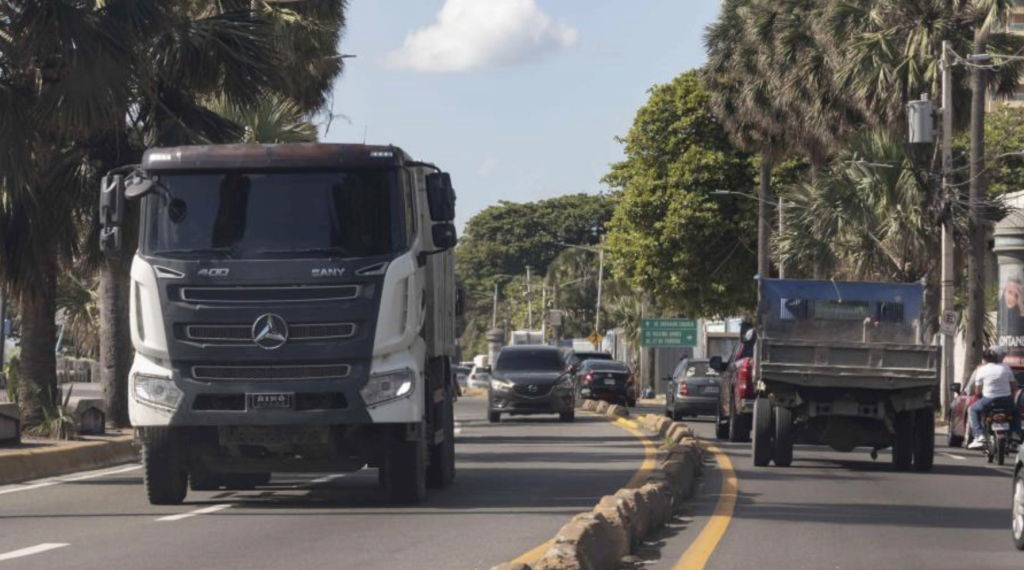
In an editorial in the Diario Libre Tintineo page two section, Omar Santana writes on the need for the president of the Truckers Association (Fenatrado) to back the ban on heavy trucks transiting on the Malecon. The president of Fenatrado is Ricardo de los Santos, who is also the president of the Senate.
The editorial comes at a time when the city government of the National District has announced the continuing of the Malecon bordering city park area all the way to Km 9 and the construction of a major city park of around 50,000 meters on the grounds of the Maharishi school.
Santana writes:
“The Santo Domingo Mayor’s office has introduced a bold, yet controversial, measure aimed at regulating heavy traffic along the city’s iconic Malecón, from the Luperón Avenue to the Don Diego Port.
“This move is no small matter. It directly impacts the powerful National Federation of Dominican Transport (Fenatrado), whose leader, Ricardo de los Santos, also heads the Senate. Additionally, it affects influential business groups. Beyond the immediate impact on truck traffic along the Malecón, the measure will also influence heavy vehicle circulation in other areas of the city. As such, its success should not be solely judged by its ability to limit trucks with more than two axles from entering the Malecón.
“The push to restrict heavy vehicle circulation on the Malecón is not a new idea. During Roberto Salcedo’s administration, initial ordinances aimed at this goal were introduced, largely driven by councilors Waldys Taveras and Consuelo Despradel. These measures focused only on the hotel zone and failed to endure over time. Subsequent efforts also lacked long-term impact.
“The growing demand for tourism and recreation along the Malecón, which spans more than seven kilometers, combined with urban development plans, makes limiting heavy traffic in the area essential.
“Santo Domingo’s Malecón must evolve into a space that caters more to tourism, recreation, and commerce, rather than continuing to be a thoroughfare dominated by cargo vehicles. This transformation began decades ago with the recovery of areas like the Eugenio María de Hostos and Güibia parks, the recent addition of the karting track, and the restoration of the monument to Fray Antón de Montesinos. The growing presence of restaurants and the spontaneous use of the space by the public have further brought the area to life. Ongoing projects, such as potential developments on the site of the former Maharishi, indicate continued interest in revitalizing the area. Now, it’s time to support a measure that, though inconvenient for some, is necessary for the city to fully embrace its connection to the sea.”
Read more in Spanish:
Diario Libre
13 February 2025