

In the face of ongoing debate over the pros and cons of mining, Environment Minister Paíno Henríquez has called for the Dominican Republic to establish a clear national policy on mining and the use of mineral resources, as reported in Hoy.
“The Dominican Republic needs to decide what we’re going to do with mining in the future,” Henríquez said. “We have ongoing discussions about mining, with some in favor and others against. But as a country, we need to define our public policy on whether or not we will utilize our mineral resources.”
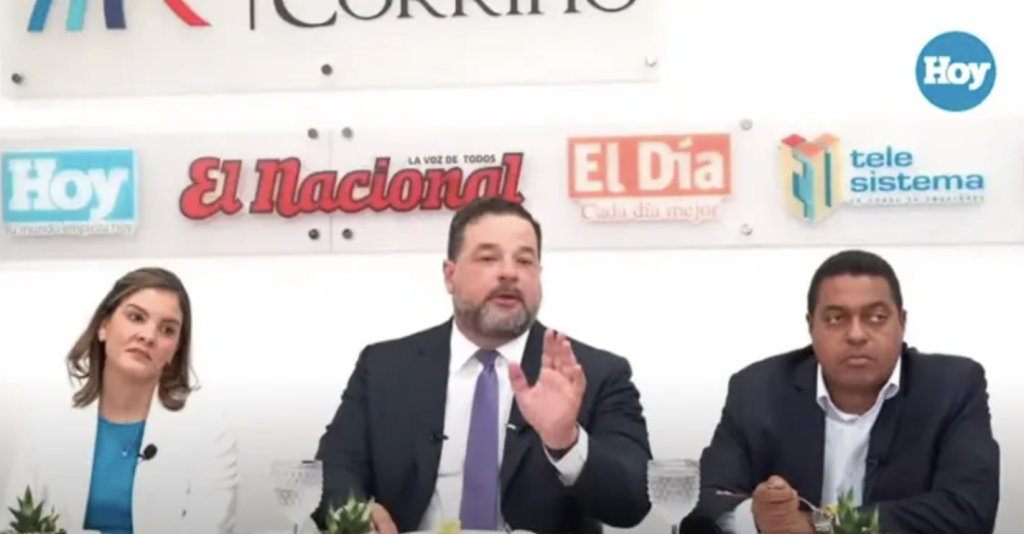
Henríquez made the remarks during a weekly luncheon with the Corripio Communications Group. He was accompanied by Ana Emilia Pimentel, Vice Minister of Climate Change and Sustainability; General Ángel Camacho Ubiera, director of the National Environmental Protection Service (SENPA); Rayne Paulino, administrative and financial coordinator; and Juan Pichardo, communications director.
Rare earth explorations
Henríquez was asked about the potential exploitation of rare earth elements in the Sierra de Bahoruco. He said he did not have the information to say whether or not such exploitation would be in the country’s best interest, as the Ministry he leads has not received any formal requests.
He added that current explorations in the area are limited to taking samples for analysis abroad. “That’s the only thing that has been authorized, and it has no impact because the samples are very small.”
Henríquez did not specify which part of the Sierra de Bahoruco National Park falls within the Ávila Fiscal Reserve, which was declared in 2018 due to interest in the potential exploitation of rare earth minerals.
Gold in San Juan
Regarding Goldquest’s project to mine gold in the province of San Juan, Henríquez said the company’s request for Terms of Reference for the Environmental Impact Assessment (EIA) is still under evaluation. The EIA will determine the project’s feasibility.
Asked about opposition to the EIA in some sectors of the province, he said it was ideal for the study to be carried out and discussed, as this would ensure greater transparency. “This Ministry will face this issue with the necessary responsibility and transparency,” he said.
Henríquez also expressed support for amending the Mining Law, which currently allows exploitation permits to be granted before the EIA.
“This is being worked on because it’s a matter of legal certainty,” he said. “How can you give a definitive license to a project that has not been previously evaluated environmentally?”
He clarified that the Ministry of Environment can carry out evaluations before granting permits so that the President has the necessary information before issuing an exploitation license.
Barrick Gold
Regarding Barrick Gold’s mining operations in Cotuí, Henríquez said that monitoring is carried out every six months and that no contamination has been detected so far.
He added that the Ministry of Environment has approved an impact study on the area’s flora and authorized the construction of a housing project for more than 500 homes.
Pomier Caves
Another issue of public concern is the destruction of the Pomier Caves Reserve in San Cristóbal, where limestone mining has significantly impacted this protected area.
Henríquez said this is a decades-old problem involving conflicts over mining concessions granted before the declaration of the protected area, as well as illegal concessions. He said President Luis Abinader will announce a final decision on the matter during his address to the country from the National Assembly on 27 February 2025.
Farallones
Regarding the destruction of the Farallones on the Ecológica Avenue of Santo Domingo Este, Henríquez said 19 homes have been removed and that some cases will be taken to court. He noted that some people have property titles in this protected area and authorizations for land use that must be investigated.
Read more in Spanish:
Hoy
20 February 2025