

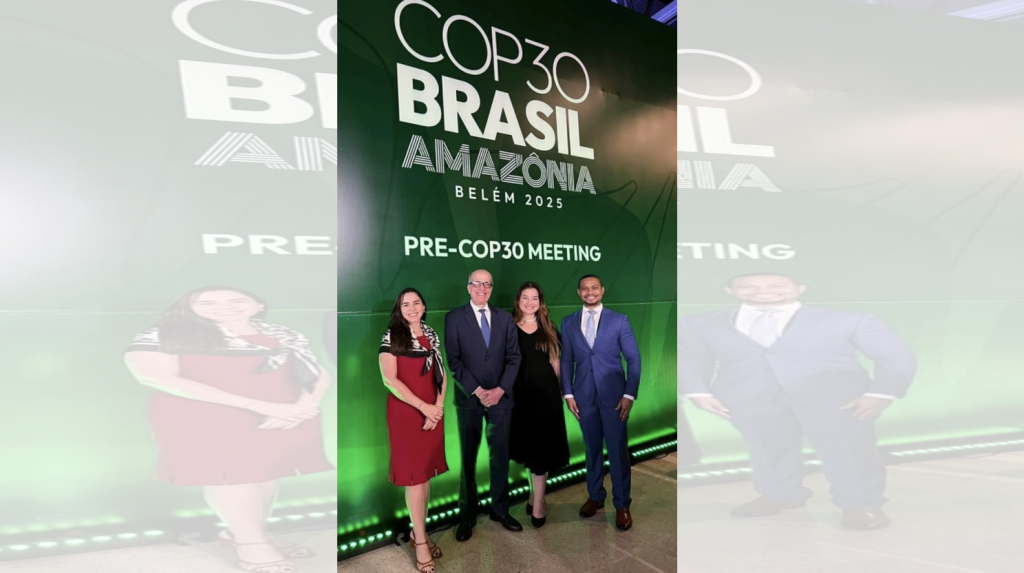
The climate change agenda has become a fundamental driver for economic and social transformation in nations worldwide, according to Max Puig, president of the Dominican Republic’s National Council for Climate Change and Carbon Market (CNCCMC). Puig made the remarks while participating in the preparatory meeting for COP30 (Pre-COP) held in the capital of Brazil.
During his address, Puig, who also serves as the CNCCMC’s executive vice president, stressed that the severe impacts of climate change are compelling societies to transform. “The grave effects of climate change force all societies to transform, modifying their modes of production and consumption, and conditioning their development agendas and new forms of social organization,” he stated.
The senior official warned that climate change and its associated risks are reconfiguring the global economy. He underscored that “the cost of inaction is too high,” making the transition to a resilient, low-carbon, and inclusive economy an urgent imperative.
“Climate change demands that we transition toward a more equitable economy, where all productive sectors are active agents of transformation and no one is left behind,” Puig emphasized.
Puig further argued that economic growth alone is insufficient to guarantee sustainable development.
“The issue is not just to grow, but to grow well. We must decarbonize the economy, advance the energy transition, and ensure greater social equity simultaneously. All of these are challenges as complex as they are urgent,” he pointed out.
A structural challenge for small island states
For the Dominican Republic, a small island developing state highly vulnerable to climate change, Puig highlighted that the challenge is not only environmental but also structural, economic, and social. This, he noted, necessitates clear and coherent political decisions.
He also stressed that innovation and a new concept of development must guide climate finance flows, ensuring international resources genuinely propel the necessary transformation in less-developed and vulnerable nations like the Dominican Republic.
Puig concluded by acknowledging Brazil’s efforts to ensure the success of COP30—dubbed “the Implementation COP”—and praised the innovative ideas put forth by the event’s presidency.
The Dominican delegation at the Pre-COP was led by Max Puig and included Gabriela Márquez from the Ministry of Environment, Domingo Melenciano from the Ministry of Foreign Relations, and Sara González from the National Council for Climate Change and Carbon Market.
Read more in Spanish:
Cambio Climatico
22 October 2025