

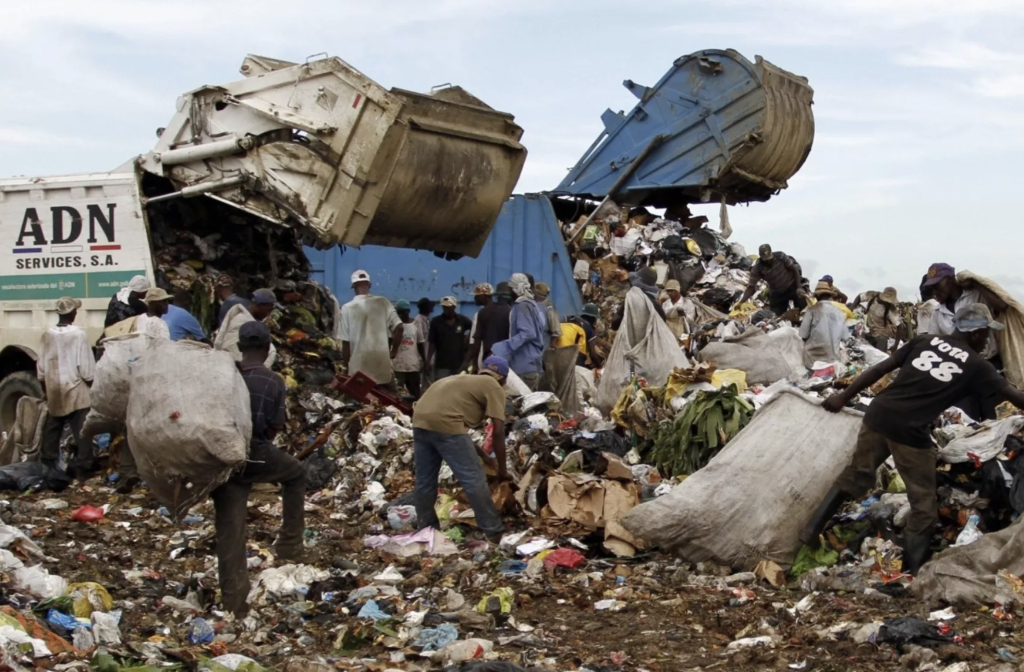
Minister of Environment Paino Henriquez says that the long-awaited closure of the Duquesa open-air landfill, considered one of the largest in Latin America and a major source of pollution in Greater Santo Domingo, is slated to begin in the first quarter of next year.
The minister confirmed that the bidding process for the first phase of the landfill’s closure has been successfully completed, marking a critical step in addressing what he described as the nation’s “worst environmental disaster.”
“I can proudly say that we are going to undertake the management that will remedy the worst environmental disaster in the Dominican Republic,” Henríquez stated during a luncheon with the Corripio Communications Group.
The closure and remediation project will proceed with support from key international partners: the Inter-American Development Bank (IDB), the Spanish Cooperation office, and the Japan International Cooperation Agency (JICA).
Duquesa currently poses a significant environmental threat, particularly to the Isabela and Ozama river basins, which absorb an estimated 500 tons of waste daily.
In anticipation of the closure, Minister Henríquez highlighted the progress made in establishing new, modern waste management facilities across the country. This shift has been facilitated by the approval of Law 225-20 on Comprehensive Management and Co-processing of Solid Waste, which has spurred public-private investments.
The minister explained that this legislation is driving the formation of a new solid waste management industry, similar to systems in other countries. The goal is to prevent the creation of future open dumps by processing waste at valorization plants and engineered sanitary landfills.
“They treat the waste in a way that allows us to take advantage of valorizable materials, including plastic, cardboard, metals, among others. That waste is treated, and the remaining fraction goes to a sanitary landfill, which is an impermeable area where the waste is placed, covered, and the methane gas is harvested for industrial use,” he detailed.
Henríquez pointed to several successful projects already underway. He mentioned a project in Higuey in La Altagracia province that has successfully controlled the toxic smoke from burning garbage that previously affected the hotel zone. He also mentioned another in San Francisco de Macorís where waste is being converted into Refuse-Derived Fuel (RDF) to power industrial boilers for energy production. “We are becoming a reference in the Caribbean for the technology being used across the country to treat waste,” he emphasized.
Looking ahead, the minister revealed that three sites have been identified in Greater Santo Domingo for the development of new waste treatment plants: one in Haina, another adjacent to the Duquesa landfill, and a third in La Cuaba. Furthermore, in the East, a plant is operational at the Gautier landfill in Boca Chica, and another project is under development in San Pedro de Macorís, championed by baseball player Robinson Canó.
Nevertheless, Minister Paino also highlighted that people in Greater Santo Domingo are generating more garbage than expected. He said that around 6,000 tons of garbage are collected daily, which was the amount that had been forecasted for population growth by 2030.
In the interview with El Dia he also spoke of the challenges of areas such as Sierra de Neiba that faces severe issues due to illegal logging and deforestation, leading to significant problems with soil erosion and reduced soil permeability. Or the southern region where the areas around the Sabana Yegua Dam exhibit high levels of deforestation. He also mentioned historical challenges in the Constanza and Valle Nuevo areas where environmental recovery needs to continue to be addressed.
During the interview with the Corripio media group, Henríquez championed the role of financial mechanisms in supporting environmental goals, specifically citing the implementation of carbon markets and green bonds to encourage investment in forestry and sustainable projects. He said that over the past two years, the Dominican Republic has issued US$750 million in green bonds, primarily targeting sustainable transport and energy initiatives. He said this commitment has solidified the nation’s position as a regional benchmark in environmental finance.
Minister Paino Henriquez has been emphatic in his interviews, linking environmental protection directly to economic stability. “The environment is neither a luxury nor a hobby; it is the only guarantee of sustainability for our agriculture, tourism, and quality of life,” affirmed the official in his interview with the Corripio Group. He underscored that forest recovery is not merely an ecological necessity but also represents a significant economic opportunity for the nation.
Read more in Spanish:
El Dia
El Dia
Diario Libre
4 December 2025