

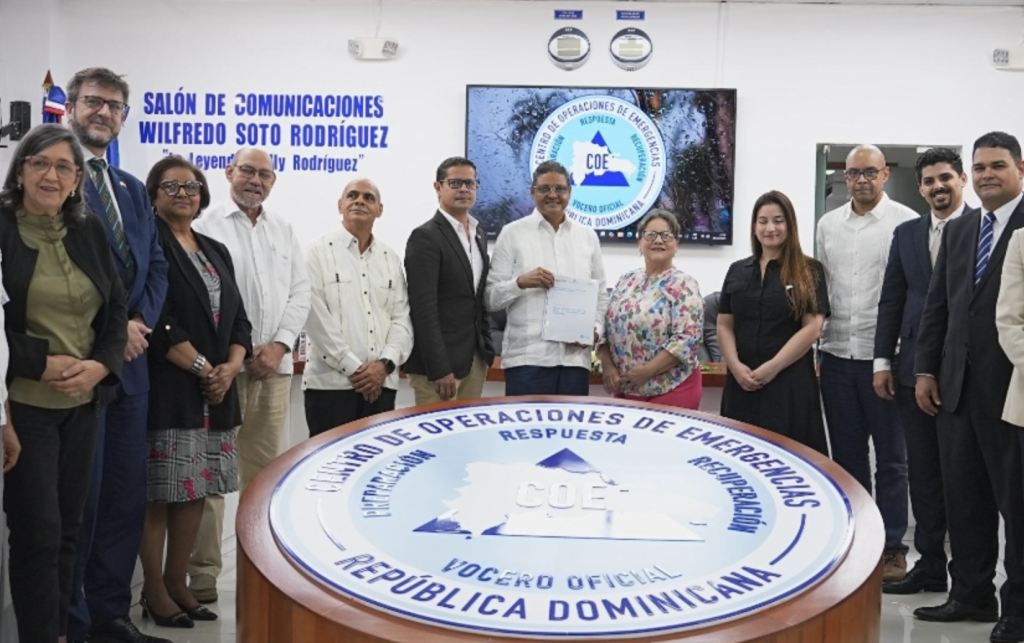
The Dominican Republic has taken a major step for disaster readiness with the start of its newly installed early warning system. The Multi-Hazard National Early Warning System (SAT-M) project is intended to significantly strengthen the national emergency response capacity.
The initiative, led by the Center for Emergency Operations (COE), aims to enhance the country’s capacity to anticipate, monitor, and respond to emergencies. It was developed in collaboration with the National Council for Climate Change, the Ministry of Economy, Planning, and Development (MEPyD), and the Global Green Growth Institute (GGGI). The project received financial backing from the Coalition for Disaster Resilient Infrastructure (CDRI) through the Infrastructure for Resilient Island States (IRIS) program.
During the official start ceremony, project leaders presented several key technical and governance achievements:
• Multi-Hazard Early Warning System Framework: Establishing a clear operational and structural guide for the SAT-M.
• Emergency Risk and Vulnerability Atlas (ARVE): A comprehensive tool that consolidates over 70 layers of official geospatial data, integrating information on threats, exposure, vulnerability, and response capacity at the national, provincial, and neighborhood levels.
• Impact Geo-Register: A system that allows users to consult and cross-reference information on 1,326 events and 314 georeferenced impacts recorded since 1925, providing an evidence-based approach to planning and decision-making.
• Neighborhood Emergency Response Index (IRBE): A metric to gauge local community readiness.
• Alerta-COE Application: Significant progress was made on this application, which will enable the issuance of more geolocalized and standardized alerts, improving the specificity of public warnings.
The Impact Geo-Register is particularly vital for historical analysis, ensuring that future planning is grounded in past experiences.
A major institutional milestone of the project was the establishment of a collaboration agreement between the COE and the National Statistics Office (ONE), ensuring a continuous flow of official, verified data to power the new system.
The development of SAT-MA was financed through significant international cooperation. Thanks to intersectoral coordination led by the National Council for Climate Change and Clean Development Mechanism (CNCCMDL), the Dominican Republic secured funds from the Coalition for Disaster Resilient Infrastructure (CDRI), an organization championed by the Government of India. The funding was channeled through CDRI’s Infrastructure for Resilient Island States (IRIS) program, specifically dedicated to supporting the development of the SAT-MA.
The effort is conducted under the coordination of the Ministry of Economy and the CNCCMDL benefits from the technical advisory expertise of the Global Green Growth Institute (GGGI).
Read more in Spanish:
El Dia
Climate Change Agency
4 December 2025