

The seventh session of the UN Environment Assembly (UNEA-7) concluded on 12 December 2025, with a historic commitment to tackle marine assets. Gathering over 6,000 delegates from 186 countries at the UNEP headquarters in Nairobi, Kenya, the UN Environment Assembly voted to issue 11 resolutions including Resolution UNEP/EA.7/L.3) that addresses sargassum seaweed blooms, paired with a sweeping mandate to accelerate the climate resilience of coral reefs.
For the Caribbean and Central America, the resolution represents a vital shift from local crisis management to a coordinated global response. The region has long struggled with the dual threat of “brown tides” (sargassum) and “white death” (coral bleaching).
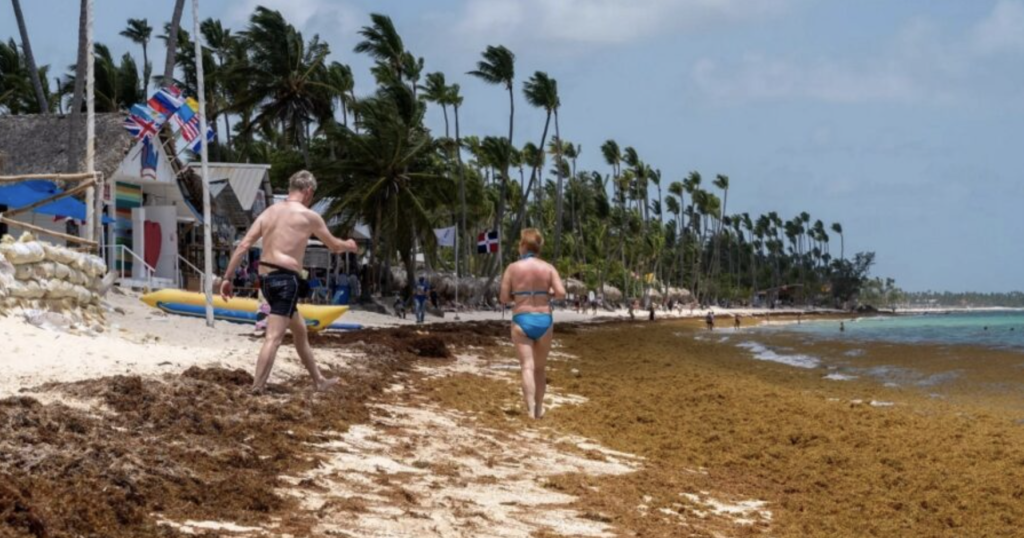
Massive blooms of sargassum have choked coastlines, devastated the tourism sector, and decimated local fisheries. The new resolution formally recognizes sargassum as a global environmental priority, opening doors for international cooperation and standardized management strategies.
Coral reefs support 25% of marine biodiversity and generate an estimated $9.9 trillion in annual ecosystem services. In the Caribbean, these reefs act as natural storm barriers and are the backbone of the blue economy.
The resolution (UNEP/EA.7/L.3) outlines a roadmap for nations to safeguard their marine assets through three primary avenues. Member States are urged to embed coral and sargassum management into national biodiversity and climate action plans. The resolution has provisions that encourage the voluntary contribution of expertise to the Global Coral Reef Monitoring Network to ensure decisions are backed by real-time science. Likewise, the resolution calls for the urgent mobilization of financial resources to bridge the massive funding gaps in marine conservation.
The adoption of these resolutions is expected to trigger several immediate shifts for Caribbean and Central American nations.
By requesting the UNEP executive director to develop “voluntary guidance” for monitoring and restoration, the resolution provides a standardized playbook for countries that previously lacked the resources to tackle sargassum alone.
By prioritizing the resilience of reefs and the management of seaweed, the UN is directly supporting the livelihoods of nearly one billion people globally who depend on healthy ocean.
The formal recognition of these issues at the UNEA level makes it easier for developing nations in the “Sargassum Belt” to apply for international climate finance and technical assistance.
“Strengthening reef resilience is a key strategy for coral reef survival,” the resolution states, emphasizing that without urgent intervention, the ecological and cultural significance of these ecosystems could be lost.
The UN Environmental Agency reports that after the summit in Nairobi, the focus now shifts to the shores of the Caribbean, where the implementation of these resolutions is expected to impact the future of the region’s blue economy.
Read more:
UNEP
Resolution UNEP/EA.7/L.3
El Dia
17 December 2025