

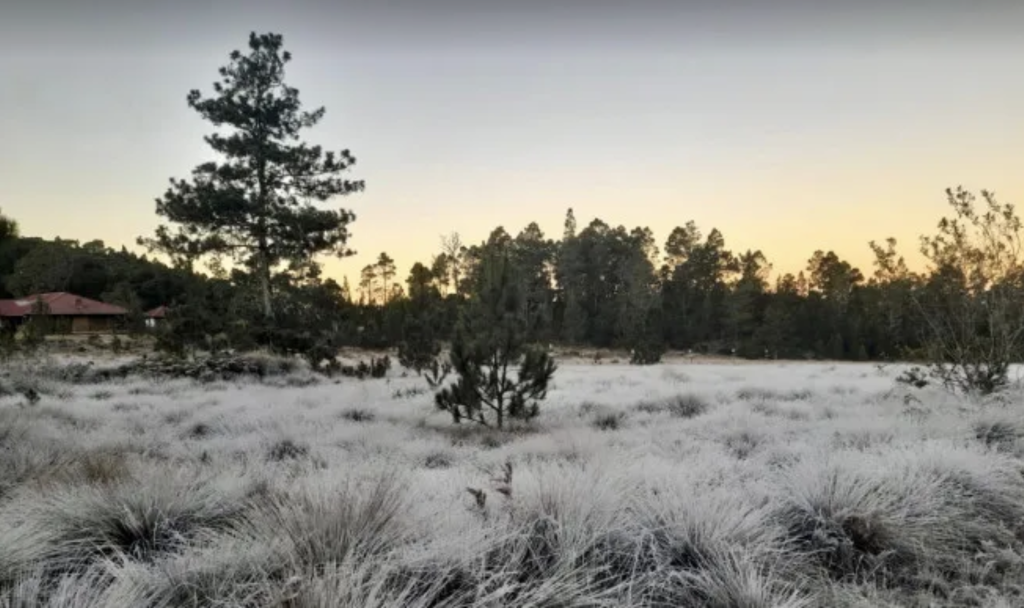
A feature in Hoy newspaper on 28 December 2025 explains the white phenomenon that coats the Valle Nuevo, the mountain plateau that sits between 2,200 and 2,400 meters above sea level in central La Vega province. The area’s highest peak, Alto de la Bandera, reaches an elevation of 2,842 meters. The area is frequented by those who want to experience the coldest it gets in the Caribbean.
For years, around this time of the year, social media regularly shares images of Valle Nuevo covered in a pristine white layer. These often leave Dominicans in awe, as the landscape appears to be a Nordic country rather than a scene from a Caribbean island. While the scenery frequently sparks rumors of snowfall in the tropics, meteorologists clarified for Hoy newspaper that the white blanket is actually a distinct phenomenon known as cencellada blanca, or rime ice.
Rime ice is a white, opaque, and often feathery or spiky ice deposit that forms when supercooled water droplets from freezing fog or clouds freeze instantly upon contact with surfaces like trees, power lines, or aircraft. It’s characterized by trapped air, making it light and porous, unlike clear glaze ice, and it builds up on the windward side, sculpted by the wind.
Saddan Font-Frías Montero, the senior engineer in charge of the National Forecasting Center at the Dominican Institute of Meteorology (Indomet), explained that while the visual effect resembles a snowfall, the scientific origin is quite different.
“Rime ice is a phenomenon that can occur in the coldest areas of the Dominican Republic, especially during the North Atlantic winter,” Font-Frías Montero told the Hoy reporter Marilenny Mueses.
According to Font-Frías Montero, the phenomenon is most frequently observed in high-altitude areas such as Valle Nuevo and Constanza. It occurs through a process of radiative cooling.
“Rime ice forms when surfaces and objects exposed to radiative cooling, such as vegetation, act as condensation nuclei,” he explained.
Unlike snow, which falls from clouds as ice crystals, rime ice forms at ground level. Small water droplets found in fog deposit themselves onto cold surfaces, such as plants, branches, and the soil, and freeze upon contact. This accumulation creates the characteristic white mantle that creates the illusion of a snowy landscape.
While rare in the wider Caribbean, Font-Frías Montero assured that the phenomenon is entirely normal for the country’s highest elevations, where temperatures can drop significantly during the winter season.
On Thursday, 26 December 2025, the temperature in Constanza, La Vega province, dropped to a minimum of 7 degrees Celsius (44.6°F), providing the right conditions for these events.
These frigid conditions are associated with the onset of the frontal season, which runs from late October through March. During this period, cold fronts originating in North America push toward the Caribbean, bringing temporary temperature drops, increased northeasterly winds, and conditions favorable for the formation of fog and rime ice in mountainous regions.
29 December 2025