

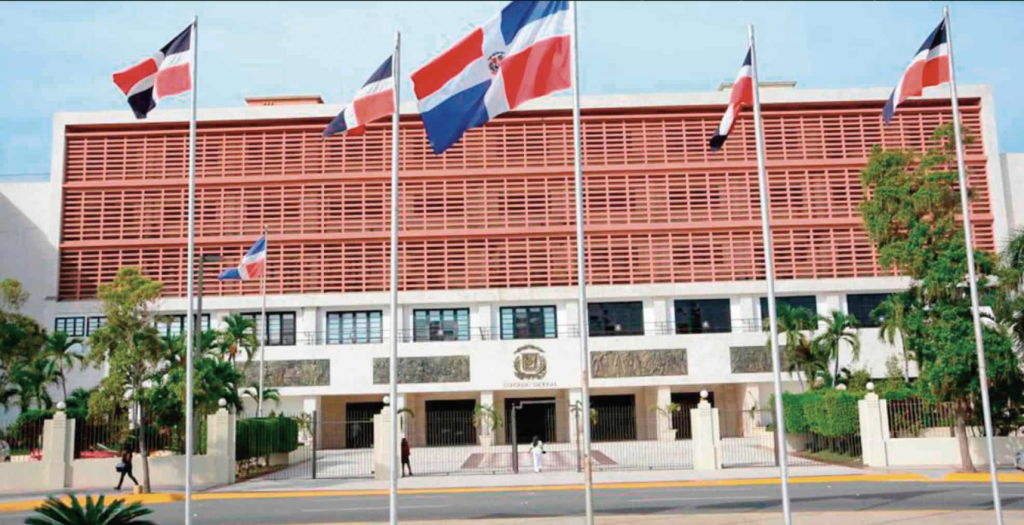
The Dominican National Congress approved nine loan agreements requested by the administration of President Luis Abinader throughout 2025, authorizing more than US$1.43 billion in new sovereign debt, Diario Libre reported in a recap of the allocation of the funds.
According to contracts reviewed by both legislative chambers, the funds are earmarked for budget support, public health, sanitation, electrical energy, potable water, road infrastructure, transportation, environmental projects, and the strengthening of the agricultural sector.
While the ruling Modern Revolutionary Party (PRM) leveraged its congressional majority to ratify the agreements without procedural obstacles, the measures faced uniform rejection from opposition legislators. Dissenting lawmakers argued that the tangible results of the government’s borrowing strategy remain unseen.
Some of these financing initiatives were initially approved by the Chamber of Deputies in late 2024 and received final sanction from the Senate in January 2025.
Among the loans is a US$45 million agreement ratified in January 2025 with the Japan International Cooperation Agency (JICA). This funding is directed toward the Comprehensive Solid Waste Management Improvement Project, implemented by the Ministry of Environment, with a specific focus on closing the Duquesa landfill.
During the same period, the Senate voted in favor of a US$400 million loan from the International Bank for Reconstruction and Development (IBRD/World Bank). This substantial loan is designated for budgetary support of sustainable development policies and efforts to “protect natural capital as a basis for economic growth.”
Following the January sessions, Congress did not review new loans for five months. Activity resumed in May with the approval of a US$75 million agreement with the Development Bank of Latin America (CAF) to finance the Program to Support the Improvement of Electricity Distribution Networks.
These resources are to be executed by the government distribution companies Edesur, Edeeste, and Edenorte, targeting interventions in various provinces to reduce blackouts and improve supply quality.
For the health sector, Congress greenlit a US$50 million financing package from the Inter-American Development Bank (IDB) in May. This project aims to strengthen the health system’s ability to prevent and manage chronic non-communicable diseases, with a focus also on diabetes and cardiovascular conditions.
In July, legislators approved a US$380 million IDB loan for the second phase of the Universal Sanitation Program in Coastal and Tourist Cities, implemented by the National Institute of Potable Waters and Sewerage (Inapa). This financing aims to expand sanitation coverage in cities such as La Romana, San Pedro de Macorís, and Higüey, while strengthening institutional water management.
Also sanctioned in July was a US$35 million loan from the CAF for the expansion of the Barrera de Salinidad Oriental Aqueduct and its transfer to Santo Domingo North. The government announced that this work, executed by the Santo Domingo Aqueduct and Sewerage Corporation (Caasd), would be delivered between late 2025 and early 2026, benefiting approximately 850,000 residents.
Regarding road infrastructure, Congress approved a US$200 million IDB financing package in July for the Bridge Infrastructure Climate Resilience Program. Executed by the Ministry of Public Works, the program covers the construction and rehabilitation of rural and urban bridges, incorporating climate change adaptation and disaster risk management criteria.
In the current legislative session, which began in August, lawmakers had not reviewed loans until their final week of work in December. In a flurry of year-end activity, they voted in favor of a credit agreement with the French Development Agency (AFD) for US$178.4 million to expand the transport capacity of Santo Domingo Metro Line 2. The project, managed by the Office for the Reorganization of Transportation (Opret), seeks to improve the mass transit system’s operational capacity to match the recent expansion of Line 1.
Additionally, a loan agreement with JICA for 10.93 billion yen (approximately US$69.9 million) was approved to fund the Project for the Improvement of Agricultural Financing and the Strengthening of the Food Value Chain.
Diario Libre reports that in response to criticisms regarding the volume of loans approved during the Abinader administration, the Finance Committee of the Chamber of Deputies reviewed a draft resolution to summon the Minister of Finance and Economy, Magín Díaz, to explain the scope and use of the borrowed funds. However, the initiative did not prosper.
During the final session of the year, Deputy Charlie Mariotti Jr. of the Dominican Liberation Party (PLD) specifically criticized the debt incurred for the Santo Domingo Metro. He argued that despite billions of dollars allocated for improvements, “the results are not visualized.”
Mariotti Jr. clarified that while borrowing is not inherently bad, the administration is signing debt agreements for works where results “are not seen,” insisting that society must be able to perceive the outcome in tangible infrastructure or execution.
A similar stance was taken by Deputy José David Báez of the People’s Force (Fuerza del Pueblo), who stated that “the people do not trust” the loans because the works for which the government incurs debt “are not evidenced.” He called for greater fiscal oversight to ensure that borrowed resources are not diluted.
Read more in Spanish:
Diario Libre
6 January 2026