

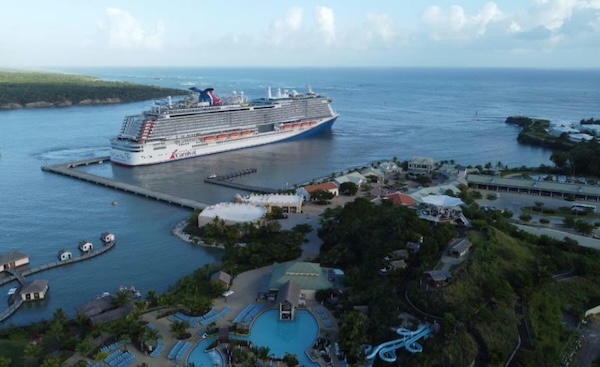
The Dominican Republic has solidified its position as the premier cruise destination in the Caribbean, closing 2025 with a record-breaking 2,815,732 maritime visitors. According to the latest year-end report from the Ministry of Tourism (Mitur), this figure represents a 6% increase over 2024 and a staggering 114.6% growth compared to 2022.
Tourism Minister David Collado presented the statistics, highlighting that December alone saw 415,902 cruise arrivals, contributing to a historic total of 11.6 million visitors when combined with air travel. The surge was driven largely by the northern province of Puerto Plata, which remains the country’s maritime powerhouse. The Taíno Bay terminal welcomed 1,126,485 passengers—a 13% year-over-year increase—while Amber Cove recorded 1,076,149 arrivals. Together, these two ports accounted for nearly 80% of the nation’s total cruise traffic.
Other significant contributions came from La Romana, which received 278,791 passengers, and the emerging destination of Cabo Rojo in Pedernales, which is projected to continue its rapid expansion into 2026.
The “Golden Cage” dilemma: High volume, low local impact
Despite the record-breaking influx of visitors, industry analysts are raising alarms regarding the actual economic benefit reaching local communities. Statistics indicate a concerning trend in passenger behavior: for every 100 tourists who dock at Dominican terminals, only three choose to take organized tours outside the port facilities.
This phenomenon was a central topic of discussion on the business program Almuerzo de Negocios, citing an El Dinero news story. Almuerzo de Negocios host José Luis Ravelo argued that the current “all-inclusive” terminal model makes this extension of the cruise ship so attractive that passengers are not motivated to see the destination. Ravelo noted that modern terminals are designed to be so self-contained, offering everything from pools and bars to retail shops and artificial attractions, that passengers have little incentive to leave.
“The model is working against the local merchant,” Ravelo explained. He suggested that because the terminals are so complete, tourists see no reason to incur the extra expense or effort of a tour, effectively keeping the “spillover” wealth within the walls of the port and the cruise lines, rather than in the hands of local tour operators and artisans.
The leading two ports in Puerto Plata and the Cabo Rojo port in Pedernales fall under the all-inclusive modality. Only in the case of La Romana do tourists have the incentive to go beyond.
Read more in Spanish:
Noticias MITUR
20 January 2026