

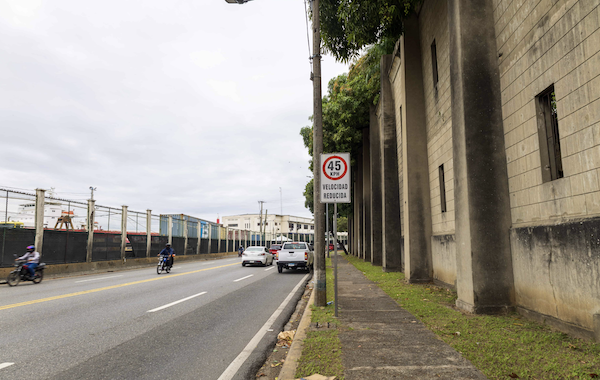
Santo Domingo authorities seek to reduce traffic deaths with a new urban initiative. The National District City Hall, working with guidance from the Partnership for Healthy Cities, has launched “Ni un chin más rápido” (Not a Bit Faster), a strategic initiative designed to transform driving habits in the capital, reports Adalberto de la Rosa in Diario Libre.
The initiative, which began with a formal ordinance and a pilot plan, is backed by Bloomberg Philanthropies and Vital Strategies. Moving forward, the project calls for stricter enforcement, the potential use of technology like tachographs for public transport, and a massive public awareness campaign to ensure that the city’s streets become safer for drivers and pedestrians alike.
The project aims to lower the standard speed limit on major thoroughfares from 60 km/h (37 mph) to 50 km/h (31 mph), a threshold the World Health Organization (WHO) identifies as critical for saving lives in urban environments.
“At 50 kilometers per hour, we still have time to brake, to react, and to avoid a tragedy,” said Elizabeth Mateo, Secretary General of the National District City Hall. Mateo emphasized that the program is not merely a marketing campaign but a long-term “behavioral change program” supported by technical studies and international evidence.
The speed limits
Under current Law 63-17, speed limits in the National District are already strictly defined, though often ignored or unknown by the public:
• Main avenues (27 de Febrero, John F. Kennedy, Máximo Gómez): 60 km/h
• George Washington Avenue (El Malecón): 30–35 km/h
• Port Avenue (Francisco Alberto Caamaño): 45 km/h
• Elevated Highways: Generally 60 km/h (45 km/h on the 27 de Febrero overpass)
• Residential and School Zones: 20 km/h
Despite these regulations, experts note that speeds on the Malecón are frequently doubled or tripled without legal consequence, Diario Libre reports. Furthermore, a lack of signage on major arteries like Winston Churchill and Luperón contributes to widespread driver confusion.
The science of safety
Road safety expert Juan José Castilla warns that “inappropriate speed,” driving too fast for conditions like rain or heavy traffic, is just as dangerous as breaking the legal limit. Castilla pointed to the “tunnel effect,” where a driver’s field of vision narrows as speed increases, significantly raising the risk of accidents.
“If a pedestrian is struck at 30 km/h or less, the probability of death is very low,” Castilla noted. “Beyond that speed, the risk increases considerably.”
Read more in Spanish:
Diario Libre
5 February 2026