

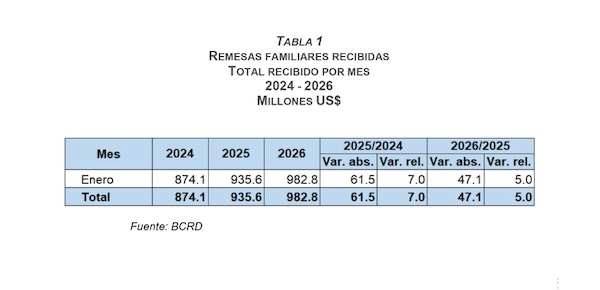
The Central Bank of the Dominican Republic (BCRD) reported Sunday, 15 February 2026 that remittance inflows reached US$982.8 million during January 2026, marking a 5.0% increase compared to the same month last year. This robust start to the year suggests that the upward trend observed throughout 2025 remains firmly in place, providing a critical cushion for the national economy.
According to the BCRD, these funds from the Dominican diaspora act as a “multiplier effect” for the nation, driving domestic consumption, boosting local investment, and providing vital financial support to the country’s most vulnerable sectors.
US economic resilience drives growth
The Central Bank identified the economic performance of the United States as the primary engine behind the figures, with 79.4% of all formal flows originating from the United States. Analysts point to a stable American labor market as a key factor; the US general unemployment rate stood at 4.3% in January, a slight improvement from the 4.4% recorded in December 2025.
Furthermore, the Institute for Supply Management (ISM) Non-manufacturing Purchasing Managers’ Index (PMI) held steady at 53.8 in January. This marks 19 consecutive months of expansion in the service sector, the industry where a significant portion of the Dominican diaspora is employed.
Global contributions and Regional Distribution
While the U.S. dominates with 79.4% of the remittances, Dominicans living in Spain sent 7.3% of the total, followed by 1.5% from Italy and 1.4% from Haiti and Switzerland.
Within the Dominican Republic, the National District (the capital city) received the largest share at 48.9%. Santiago followed with 10.2%, and Santo Domingo province at 7.1%. Together, these metropolitan hubs account for 66.2% of all incoming funds.
Despite the implementation of a new 1.0% tax on outbound transfers from the United States, the BCRD maintains a growth projection of 3.5% for the full year 2026. The Central Bank anticipates a “minimal impact” from the levy because it specifically targets cash transactions while exempting bank and digital transfers.
The BCRD noted that the Dominican diaspora is uniquely positioned to weather this policy change due to high levels of banking integration and a 56.0% naturalization rate, which facilitates tax reimbursements. Research from the Center for Latin American Monetary Studies (CEMLA) further confirms that this tax represents only a marginal fraction of the total wages earned by Dominicans abroad.
External stability and reserves
The January figures contribute to a positive outlook for the country’s external sector. The BCRD expects total remittances to reach US$12.2 billion by year-end, while Foreign Direct Investment (FDI) is projected to exceed US$5 billion.
This influx of hard currency has been instrumental in shielding the Dominican peso from volatility. As of 31 January 2026, the national currency had depreciated only 0.2% against the US dollar since December. Additionally, international reserves closed the month at US$13.96 billion, equivalent to 10.6% of GDP and 4.9 months of imports—surpassing the stability thresholds recommended by the International Monetary Fund (IMF).
Read more in Spanish:
Central Bank
16 February 2026