

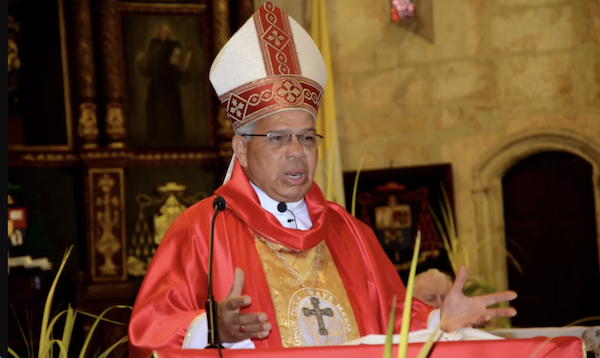
The recent Vatican intervention in the Archdiocese of Santo Domingo has laid bare a long-festering crisis of transparency within the Dominican Republic’s most powerful religious institution. The effective removal of Metropolitan Archbishop Francisco Ozoria Acosta from administrative and financial governance, relegating him to a largely ceremonial role, is being viewed by observers not as an isolated scandal, but as the inevitable collapse of a system long protected by institutional silence and a lack of external oversight. Ozoria has yet to reach the retirement age of 75 years in October of this year.
A culture of institutional silence
For years, allegations of mismanagement and irregularities within the archdiocese remained a matter of vox populi, widely discussed in private and local media but met with persistent silence from the Church hierarchy. It was only after reports of “certain accusations” regarding the management of diocesan assets reached the Holy See that Pope Leo XIV took the rare step of granting a coadjutor, Archbishop Carlos Tomás Morel Diplán, “special powers” to seize total control of economic and personnel affairs. Morel had made his career under Ozoria.
The delay in addressing these irregularities has highlighted a systemic failure where internal “mismanagement” could persist without formal admonishment or public explanation. Ozoria himself expressed surprise at the suddenness of the Vatican’s move, claiming he was never officially warned of the charges against him.
The Nuria Piera TV report reveals that in recent years the government provided taxpayer funds for the construction of 17 churches. The spotlight centers on a firm closely linked to the Archbishop: Trazos Diseños Más Construcción (Tradisecons). Monsignor Ozoria himself assigned this company the construction of four temples: the Holy Trinity Convent (Santo Domingo Norte), San Bartolomé Apóstol Parish (Distrito Nacional), Our Lady of Altagracia Parish (Monte Plata), and Divine Child Jesus Parish (Santo Domingo Este), for a total exceeding 98 million pesos.
The contractor, Trazos, was incorporated in April 2011. Its original address was listed at 171 Independencia Avenue in San Pedro de Macorís—the same address as Francisco Ozoria Acosta’s family home. Later, in its 2018 state supplier registration, the company changed its official address to the headquarters of the Archbishopric of Santo Domingo at 55 Isabel la Católica Street in the Colonial City.
The primary shareholder of Trazos was the architect Secundino Ozoria Acosta, the Archbishop’s brother. According to documentation, Secundino Ozoria not only prepared the budgets for the projects assigned to his own firm but also for those of the other contractors, despite his signature not appearing on the documents. Secundino Ozoria passed away from liver cancer in November 2022, one year after the agreements were signed.
Notably, the person who did sign the documents as the contractor was Monsignor Francisco Ozoria Acosta himself. Other partners in the firm include his brother, José Miguel Ozoria Acosta, and his sister-in-law, Josefina Vásquez Guzmán de Ozoria.
The Concordat: A shield against oversight
A recent Nuria Piera TV journalist investigation highlights that central to this lack of accountability is the 1954 Concordat between the Dominican Republic and the Holy See. A legacy of the Trujillo era, this treaty grants the Roman Catholic Church a unique legal status that exempts it from many of the transparency requirements imposed on other civil and religious organizations.
Critics argue that this “generous” pact has created a legal vacuum where civil oversight is limited. State institutions often lack the authority to audit Church finances, despite the Church receiving abundant taxpayer funds, and shields the Church from investigations in internal personnel matters. The government frequently has authorized significant funding for carrying out of church renovations without oversight and without following protocols for previous tenders.
The Concordat fosters institutional immunity. The special privileges enshrined in the Concordat have historically discouraged public officials from scrutinizing Church irregularities, fearing political or legal repercussions.
Key information is kept internal. The treaty has been cited as a potential barrier to the Dominican criminal justice system’s ability to access information regarding past internal investigations. The hierarchy of the Roman Catholic Church in the Dominican Republic would remove dissidents to reduce those who would oppose the decisions, as occurred in the cases of Father Rogelio and Bishop Victor Masalles.
While late in coming, the Vatican’s decisive intervention signals that even the broad protections of the Concordat cannot fully shield the local hierarchy when internal failures threaten the Church’s global reputation. While Archbishop Ozoria has pledged his “obedience” to the Pope’s decision, the move has fueled intense public debate regarding the need for modernizing the relationship between the State and the Church. The status quo nevertheless calls for revision of the state and church relations.
Follow the story:
N Digital
Nuria Investiga
16 February 2026