

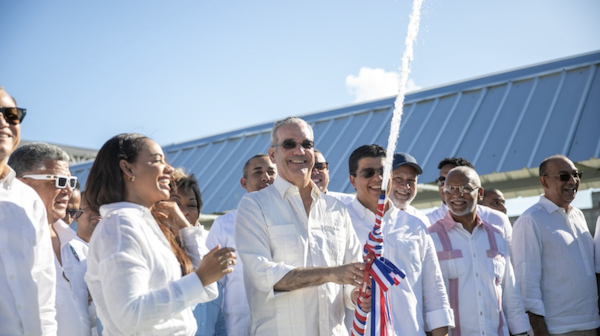
President Luis Abinader, alongside the director of the Water and Sewerage Corporation of Santo Domingo (CAASD), Felipe “Fellito” Suberví, officially put into service the historic expansion of the Barrera de Salinidad Oriental Aqueduct on Sunday, 22 February 2026. The project, now the largest pumping aqueduct in the Dominican Republic, is set to deliver over 136 million gallons of drinking water daily, directly impacting nearly two million residents in Santo Domingo East and Santo Domingo North.
The expansion represents a critical milestone for the capital’s water security, addressing decades of service instability. According to official reports, the facility’s production has been boosted to six cubic meters per second, a significant leap intended to guarantee a steady supply for the next 20 years.
A legacy project revitalized
While the current administration celebrated the completion as a “historic delivery,” the project is notably the continuation of an infrastructure plan that had been left partially executed by the previous Danilo Medina administration. Records show that in 2018, the Medina government authorized a US$97 million loan from the Latin American Development Bank (CAF) specifically for the “Expansion of the Oriental Aqueduct and Transfer to Santo Domingo North.” However, despite the initial funding and design phases, the expansion faced significant delays and remained unfinished at the end of Medina’s term in 2020.
Upon taking office, the Abinader administration inherited a system that had lost more than half of its original capacity due to lack of maintenance, producing less than two cubic meters per second. The current government chose to resume and restructure the stalled project, eventually investing a total of US$142 million—integrating the original CAF financing with an additional US$45 million in state funds — to finally bring the “halfway” project to fruition.
Technical impact and future fision
The work delivered this week includes:
• The construction of a massive new pumping station.
• The installation of four regulation tanks with a combined capacity of over 113,000 cubic meters.
• More than 52 kilometers of new large-diameter pipelines to replace obsolete infrastructure.
During the ceremony, CAASD director Fellito Suberví emphasized that this was “practically a new aqueduct,” providing the pressure and continuity that was previously impossible to achieve.
President Abinader used the occasion to announce that the government is already looking toward a “definitive solution” for the city’s growth, with a new bidding process set to begin in March 2026 for a project that will eventually add another 10 cubic meters of water per second to the regional grid.
Read more in Spanish:
Presidency
El Dia
23 February 2026