

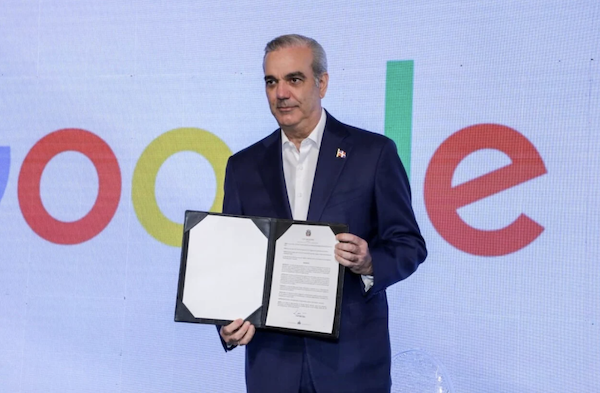
The announcement that Google is going to invest US$500 million in a project in the Dominican Republic made headlines all across every newspaper and social platform in the country over the weekend. The announcement strengthened the country’s positioning as a connectivity bridge between North, Central and South America. The DR already has excellent air and maritime connections.
Abinader signed Decree 113-26 declaring digital infrastructure a national priority and streamlining permitting for subsea cable systems. The government’s pitch is geographic: the Dominican Republic sits at the junction of data flows between North, Central and South America, a natural routing point that has been underserved by existing infrastructure.
The new digital exchange hub and subsea cable ring in the Dominican Republic is Google’s first such facility outside the United States, first in Latin America and only eighth worldwide.
For those in the Dominican Republic, the announcement means better Internet connectivity. As explained, the Dominican Republic currently relies on a single aging cable for its direct connection to the US mainland. The new infrastructure will host up to four international subsea cables, with two laid in the first phase linking directly to the continental United States. That triples direct connections and increases fiber-optic pairs tenfold — a massive jump in data capacity and a sharp reduction in latency.
As described, the hub will accommodate up to four international subsea cables, tripling direct connections to the US and increasing fiber-optic pairs tenfold, with construction starting in March 2026.
Cristian Ramos of Google Network Acquisition, told The Rios Times that the new hub will connect to two Google Cloud regions in the southeastern United States, where advanced AI and cloud computing services run. Over 95% of international data traffic moves through subsea cables, making their placement a competitive advantage for the economies they reach.
The very large construction project will create a technological infrastructure that is of the highest standards, neutral, and open. In other words, a data center or landing station, where internet service providers, content providers, and cloud companies can interconnect directly to exchange traffic locally, without going through the use of long and costly third-party services.
President Luis Abinader was pleased to announce the deal that once again pushes the Dominican Republic forward as the strategic digital hub of the Caribbean. He made the announcement on Thursday, 19 February 2026, speaking at the Presidential Palace alongside Google’s VP of global network infrastructure, Brian Quigley.
Abinader had signed Decree 113-26 declaring digital infrastructure a national priority and streamlining permitting for subsea cable systems. The government’s pitch is geographic: the Dominican Republic sits at the junction of data flows between North, Central and South America, a natural routing point that has been underserved by existing infrastructure.
Abinader pointed out that there are currently six fiber optic submarine cables, five of which have been in operation for over five years. The new infrastructure will bring two more cables directly from the United States, and create a ten-fold increase in the availability of fiber optic pairs in the country. Pairs are like a two-way street for information. The more pairs there are, the better, faster, and more stable internet service is available.
According to Google, the facility will span over 7,000 square meters. Construction should be concluded by early 2027. The location of the site was not announced.
The project fits Google’s broader push to expand subsea infrastructure globally, from the Nuvem transatlantic cable connecting the U.S. to Portugal via Bermuda, to connectivity hubs across Africa and the Indian Ocean. For the Dominican Republic, it is a chance to leapfrog from aging infrastructure to becoming a regional data gateway — the kind of strategic positioning that attracts data centers, AI companies and the high-value jobs that come with them.
In October 2025, President Luis Abinader had already announced a landmark agreement with NVIDIA to establish the Center of Excellence in Artificial Intelligence (CEIA), the first regional hub of its kind in the Caribbean and Central America. The partnership aims to bolster national digital sovereignty by training over 1,000 professionals by 2026 and creating a “National AI Factory” to drive innovation in sectors like healthcare, education, and tourism.
Read more:
Presidency
El Caribe
Diario Libre
Diario Libre
Listin Diario
Hoy
Rio Times Online
23 February 2026