

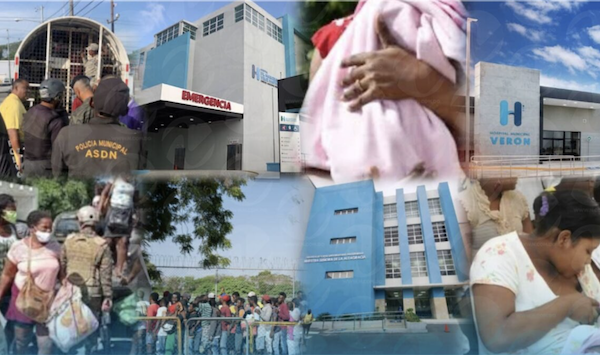
For years, Haitians crossed the border to receive free medical services. The government looked the other way. International pressures urged lenience to relieve the humanitarian crisis in Haiti where medical services are collapsed. The increase in Haitian demand for free medical services was growing as the Haitian population continues to seek the free services. One of the areas in most demand by Haitians is for birthing services.
In April 2025, nevertheless, facing immense and unsustainable pressures on public health finances, the Dominican government instated new rules that restricted birthing of Haitians that could not prove legal residence in the Dominican Republic. Statistics today reveal this has resulted in a major relief on government finances and the quality of medical services for those living in the Dominican Republic.
The new migratory protocol in effect since April 2025 enforcing residency checks at public medical facilities has led to a dramatic shift in maternity ward demographics across the Dominican Republic. According to the latest figures, births by undocumented Haitian women in the nation’s public hospitals have plummeted by more than 41 percent following the implementation of the measure.
The birthing protocol, instituted to manage the financial and operational strain on the national public health system, mandates that state-run hospitals restrict free medical services for non-legal immigrants to emergency care only. Under this framework, hospital administrators and medical staff are required to verify the legal residency or citizenship status of patients seeking routine or elective care, which includes standard prenatal tracking and scheduled birthing services.
While life-threatening emergencies and active labor complications are still treated to comply with basic human rights and medical ethics, undocumented migrants are no longer granted unrestricted access to the country’s free maternity care program and medical services. Furthermore, the protocol frequently involves coordination with the Migration Agency (DGM), meaning undocumented individuals seeking non-emergency medical services face the risk of detention and deportation.
This policy shift is a direct response to years of soaring maternal care costs absorbed by the Dominican state. For over a decade, thousands of expectant mothers from neighboring Haiti have crossed the border to access the Dominican Republic’s public healthcare system, historically overwhelming border hospitals and displacing services for locals at major maternity centers in border provinces, Greater Santo Domingo and Santiago.
Government officials argue the protocol is necessary to prioritize Dominican citizens and legal residents, ensuring the long-term sustainability of the national health budget. At the same time, human rights advocates in the Dominican Republic and abroad express alarm, warning that restricting hospital access forces undocumented pregnant women to avoid medical facilities altogether, significantly increasing the risk of maternal mortality and unregulated, out-of-hospital births. International organizations do not fund Haitian births in the Dominican Republic. The medical services situation and availability in Haiti has yet to improve.
N Digital reports on the numbers.
Before the measure:
January-April 2025 the number of births per month was on average 2,300. This declined to 1,165 average for May to December 2025.
Read more in Spanish:
N Digital
26 February 2026