

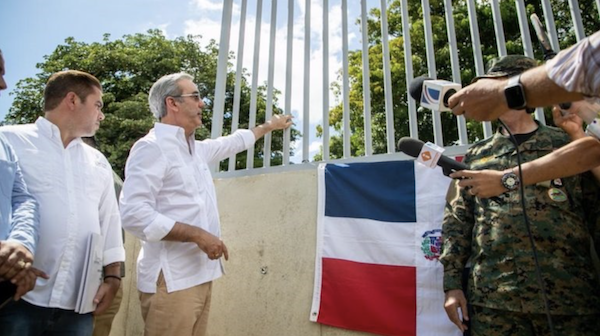
Buried in the long speech to the Congress last Friday, 27 February 2026 was the announcement of an initiative to open several “dry ports” along the border with Haiti. These are basically container (multi-modal) and logistical hubs as well as customs stations, but removed from the sea.
President Luis Abinader’s announcement on 27 February 2026 specifically highlighted a network of dry ports acting as an “economic wall” on the border.
The border project is designed to be funded by the private sector and is estimated at over US$300 million investment through public-private partnerships rather than through public debt.
There is speculation this would be in great part an expansion of DP World investments in the Dominican Republic. DP World CEO in the Dominican Republic, Manuel Martínez, had already stated in February 2026 that their goal is to develop a “fully integrated logistics and manufacturing ecosystem” tailored to the country’s strengths.
The Abinader government reasoning is that the innovation would promote industry and commerce along some of the poorest provinces. Nevertheless, Dominican border provinces are also those with some of the lowest population, contrary to the intense population on the Haitian side of the border. The area is already coping with having to provide the manpower for the resort hotels the government is building in the Pedernales area. Many question whether labor from Haiti would be needed to compensate for the lack of manpower on the Dominican side. But contrary to the Codevi installations mostly on the Haitian side, the new free zone operations would be on the Dominican side.
Meanwhile, the proponents argue the logistics hub would be a way to strengthen commercial ties with Haiti, the republic’s second largest trading partner. Advocates argue the hubs would reduce contraband by closing some of the gaps along the border.
Abinader noted that “dry ports” assist in these efforts as well as bring entire regions into the global economy. He said that the US$300 million, entirely private, investment would ensure Dominican sovereignty and contribute to the nation’s competitiveness in international business.
Recently, the transitory government in Haiti announced investments to strengthen security along the frontier for the Haitian government’s ability to collect customs duties and reduce contraband.
In recent years, DP World, of the government of the United Arab Emirates (Dubai), has stepped up its local capital investments and in addition to owning the largest port serving the National District now includes the Punta Cana International Airport (PUJ) location.
DP World is already expanding its footprint beyond its primary port in Caucedo, recently integrating with the Punta Cana Air Cargo Hub to create a multimodal national network.
While the government has not yet released a definitive list of specific private investors for the border dry ports, it is highly likely that DP World is a central strategic partner or inspiration for the project based on recent high-level agreements and public declarations.
Just weeks before the border announcement, on 6 February 2026, President Abinader met with DP World Chairman Sultan Ahmed bin Sulayem at the World Governments Summit in Dubai.
During this visit, Abinader specifically toured the Jebel Ali Free Zone (JAFZA) in Dubai. DP World confirmed they are using Jebel Ali as the “reference point” and global model for the integrated logistics and industrial ecosystem they are currently advancing with the Dominican government.
DP World recently signed a landmark Memorandum of Understanding (MoU) for a US$760 million investment program. This funding is dedicated to transforming the country into a regional logistics leader and includes expanding free trade zones and adjacent economic zones.
Read more in Spanish:
Al Momento
2 March 2026