

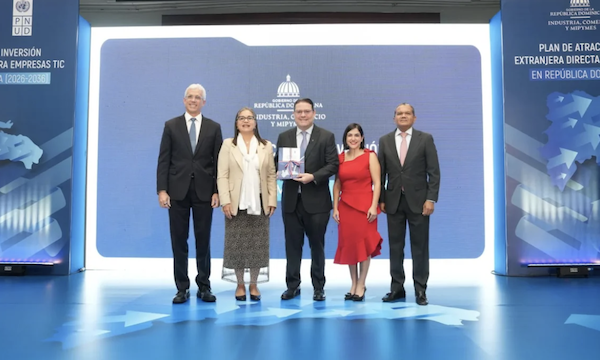
The Dominican Republic has officially launched its first Foreign Direct Investment (FDI) Attraction Plan for ICT Companies 2026–2036, a decade-long roadmap designed to position the nation as a premier regional center for high-value digital services.
The initiative, presented by the Ministry of Industry, Commerce, and MSMEs (MICM) with support from the United Nations Development Programme (UNDP), aims to integrate the country into the global value chains of the burgeoning digital economy.
A Vision for nearshoring and innovation
During the launch event on 10 March 2026, Minister Eduardo “Yayo” Sanz Lovatón emphasized that the strategy capitalizes on the global trend of supply chain relocation. He noted that the country’s stability and geographic advantages make it a “world-class tech hub” candidate.
“The Dominican Republic stands out as a reliable country with solid institutions,” Sanz Lovatón stated. “We are competitive due to our geostrategic location, connectivity, and human talent, and visionary because we have a long-term strategy.”
Key investment pillars
The 2026–2036 strategy focuses on four high-impact sectors to attract international capital:
Semiconductor Manufacturing: Tapping into the global demand for hardware components.
Software Development: Expanding the local digital ecosystem.
Healthtech: Driving the digitalization of healthcare services.
Advanced BPO: Transitioning traditional contact centers into high-level Business Process Outsourcing.
Economic Context and Global Benchmarks
The plan is backed by robust macroeconomic projections. According to World Bank estimates, the Dominican economy is expected to grow by 4.0% in 2026, significantly outperforming the Latin American regional average of 2.3%.
To ensure international competitiveness, the document was modeled after successful innovation ecosystems in Ireland, Hong Kong, and Costa Rica. These benchmarks guided the adaptation of fiscal policies, infrastructure development, and talent training to the Dominican context.
Public-private synergy
The execution of the plan involves a coordinated effort between several key institutions, including:
ProDominicana (led by Biviana Riveiro)
National Council of Export Free Zones (led by Daniel Liranzo)
Association of Foreign Investment Companies (led by Alejandro Peña)
According to authorities, this alliance will facilitate the “corporate landing” of multinational firms, promote knowledge transfer, and generate high-quality jobs in STEM fields (Science, Technology, Engineering, and Mathematics).
As the Dominican Republic embarks on this decade of transformation, the ultimate goal remains the transition toward a knowledge-based economy that fosters sustainable human development and narrows territorial gaps through technological advancement.
Read more:
N Digital
Ministry of Industry and Commerce plan
11 March 2026