

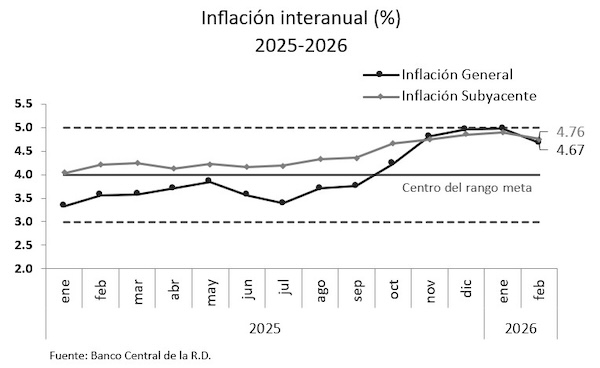
The Central Bank of the Dominican Republic (BCRD) reported Wednesday, 11 March 2026 that the Consumer Price Index (CPI) rose by a marginal 0.03% in February 2026. This stability marks 34 consecutive months that year-over-year inflation has remained within the government’s target range.
According to the official report, annual inflation settled at 4.67%, a decrease of 31 basis points from the 4.98% recorded in January. The figure remains firmly within the target of 4.0% ± 1.0% established in the nation’s monetary program, a streak maintained since May 2023.
Food supply normalizes after weather disruptions
The BCRD attributed the month’s stable performance to a recovery in the supply of high-consumption staples. Prices for fresh chicken, various types of plantains, and other agricultural products saw reductions as production normalized following heavy rains and the impact of Storm Melissa in late 2025.
As a result, the Food and Non-Alcoholic Beverages sector saw a decline of 0.56%, acting as a primary anchor against inflationary pressures. Notable price drops were seen in green and ripe plantains, fresh chicken, peppers, tomatoes and potatoes.
Likewise, the Central Bank noted price hikes in green pigeon peas (guandules), cod, beef, soft drinks, and coffee, which prevented a steeper decline in the food index.
Core inflation, which excludes volatile items like fuel and regulated services to provide a clearer signal for monetary policy, stood at 0.33% for the month and 4.76% year-over-year.
Other sectoral movements included:
• Transport (-0.20%): Driven by lower vehicle prices, despite rising airfares and repair costs.
• Restaurants and Hotels (+0.75%): Influenced by the rising cost of prepared meals, specifically daily lunch specials (plato del día).
• Health (+0.79%) and Housing (+0.29%): Reflecting increases in pharmaceutical products and rental costs, respectively.
Regional and socioeconomic impact
Inflation varied slightly across the country. The Ozama region (National District and Santo Domingo province) saw a 0.07% increase, while the North and South regions experienced slight deflations of -0.03% and -0.12%, respectively, due to the higher impact of falling food prices in those areas.
Across socioeconomic tiers, the impact was relatively uniform. The wealthiest segment (Quintile 5) saw the highest variation at 0.12%, driven by airfare costs and dining out, while the lowest-income segment (Quintile 1) recorded a minimal increase of 0.02%.
Read more in Spanish:
Central Bank
12 March 2026