

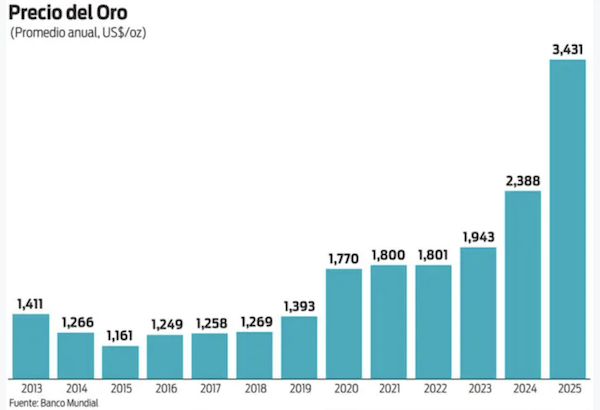
Headlines frequently tout the rising prices of gold. The Dominican Republic has the largest gold-exporting mine in Latin America and the Caribbean. The surge in gold prices is the main argument by gold companies that want the government to grant exploitation rights in vulnerable areas.
Yet, as experts have pointed out in the past, an addendum to the contract renegotiated during the Danilo Medina administration with Barrick Gold has slashed the Dominican Republic’s sharing of the price surge. The bottom line is that the extra cash is almost completely going to the mining companies.
A recent letter from former President Hipolito Mejia to President Luis Abinader raises the issue and urges the Abinader administration to take action. Mejia says that the country has lost over US$1.1 billion in mining revenue.
Former President Hipólito Mejía has formally requested an explanation from President Luis Abinader regarding the estimated US$1.113 billion in unrealized fiscal revenue from the Barrick Gold-affiliated Pueblo Viejo Dominicana Corporation (PVDC) mining operations in Pueblo Viejo, Cotuí.
Mejía is also a prominent leader within the ruling Modern Revolutionary Party (PRM). He served only one term from 2000 to 2004, losing to former President Leonel Fernandez after a chaotic administration in which the Baninter bank crash-spurred inflation sent the peso spiralling against the dollar.
Now Mejia has expressed “particular concern” over a reported fiscal imbalance caused by a failure to update technical parameters in the state’s contract with the Canadian-backed miner. The discrepancy centers on the Annual Minimum Tax (IMA), a mechanism designed to ensure the Dominican state receives a fair share of profits during surges in gold prices. His letter follows research from economist Andres (A Dauhajre.
Technical oversight or fiscal imbalance?
The inquiry follows a presentation by economist Andy Dauhajre at the José Francisco Peña Gómez Institute. According to Dauhajre’s analysis, the Dominican state failed to collect over US$1.1 billion between 2017 and 2025 because technical adjustments to the contract were not applied as gold prices evolved.
Mejía, whose 2000–2004 administration signed the original mining agreement, noted that the spirit of the contract was intended to guarantee the state a 50% share of the benefits from the Pueblo Viejo lease.
In the early stages of the Abinader administration in October 2020, the government negotiated several tax prepayments from Barrick Gold. These totalled approximately $90 million across different installments and provided immediate liquidity for the national budget. However, critics now suggest these short-term gains may have come at the expense of much larger long-term revenues.
Full Text of the Letter from Hipólito Mejía:
Santo Domingo, 02 March 2026
Lic. Luis R. Abinader Corona Constitutional President of the Republic
National Palace
City.-
Your Excellency, Mr. President:
The Political Training Institute “Dr. José Francisco Peña Gómez,” which we direct, established several years ago the Permanent Forum on Mining, Environment, and Climate Change. This forum operates under the “Chair of Environmental and Social Governance,” through which we have been developing a series of investigations, conferences, panels, and colloquiums related to matters of national interest within this field.
On Monday, 23 February, we analyzed the topic “Gold-Economy of the Dominican Republic,” featuring a presentation by the renowned economist Andy Dauhajre.
The masterly presentation focused on the fiscal development of the existing Amendment-Contract between the Dominican State and the company Barrick Pueblo Viejo (Pueblo Viejo Dominicana Corporation PVDC). The speaker concluded that, given the evolution of gold prices and due essentially to the lack of timely updates and application of technical parameters, a fiscal imbalance has arisen to the detriment of public finances that merits immediate attention.
Dauhajre asserts that, for example, during the 2017-2025 period, other considerations aside, the State failed to receive the sum of US$1,113 million in respect of the Annual Minimum Tax (IMA) contemplated in the contract.
As Your Excellency will understand, for the undersigned, under whose administration the original contract was signed, any element tending to distort the spirit that prevailed at its signing is of particular attention and concern. That spirit was intended to achieve the objective that, at a given moment, the State would participate in 50% of the benefits from the lease of mining rights at the Pueblo Viejo gold mine.
For your greater and better illustration, we have attached the analytical document supporting the considerations presented by Dauhajre.
In greeting you with the highest deference, please receive, Mr. President, our reiterated expressions of respect, distinction, and singular appreciation.
Very truly yours,
Hipolito Mejia
The explanation
On 2 February 2026, in an article in El Caribe, Dauhajre had urged the government to take action and restore the gold tax.
On 6 October 2025, gold closed at $3,909 per ounce. At the time, projections suggested the precious metal was on a trajectory toward the $5,000 mark. That milestone was officially shattered on 26 January, when gold prices surpassed $5,000 per ounce for the first time in history.
This meteoric rise has been the engine behind a surge in exports for the Pueblo Viejo Dominicana Corporation (PVDC), which saw growth of 30% in 2024 and 57% in 2025. If current price levels hold through 2026, PVDC exports could reach a staggering $3.35 billion this year.
Dauhajre explains about how the government has allowed a profit gap
While PVDC’s processing and sales costs rose by a modest 11% and 1% over the last two years, the global selling price of gold jumped by 23% and 44% respectively. This disparity has resulted in extraordinary profits for the corporation, yet the Dominican state is failing to capture its fair share of the windfall.
The mechanism designed to prevent this, the Alternative Minimum Tax (IMA), expired at the end of 2016. The IMA was a transparent, sliding-scale tax on gross export revenues that increased alongside global gold prices. Its simplicity protected a tax administration that lacked the resources to police the complex “transfer pricing” and accounting maneuvers often used by multinational mining firms.
He stresses the need for a flat revenue tax was highlighted during the 2013 contract renegotiations. At that time, PVDC had registered US$1 billion in inter-company loans from its parent company (Barrick Gold) at an interest rate of 10.29%, despite the parent company raising those funds via corporate bonds at just 1%. This maneuver allowed PVDC to “import” excessive costs to lower its local taxable income. While that specific rate was eventually lowered to 3.39%, such accounting “artifices” remain a constant risk.
The US$929 million loss
The Dauhajre financial analysis reveals the high cost of the IMA’s disappearance. Between 2022 and 2025, the Dominican government lost out on an estimated RD$54.3 billion ($929 million) in additional revenue. To put that figure in perspective, those funds could have financed:
• Two “Autopistas del Ámbar” highways.
• An entirely new line for the Santo Domingo Metro.
Dauhajre points to the significantly rising loss of revenue:
2022 8.77 billion
2023 12.18 billion
2024 13.98 billion
2025 19.38 billion
In his article, he looks ahead to 2026 and forecasts the fiscal hemorrhage is expected to worsen. In 2026, the loss of revenue could reach RD$30 billion. Under the IMA, the government would collect 32.55 cents for every dollar of gold exported at current prices. Today, it receives only 18.8 cents.
He writes that while the government reported “record” collections from Net Smelter Returns (RNF) in 2025, the figures are misleading. Of the RD$13.5 billion collected, RD$9.4 billion ($150 million) was actually an advance payment requested by the government from future 2026-2027 revenues.
He writes: “The path forward is clear: the President must issue a firm and courageous call to PVDC to restore the IMA. It is the only way to ensure the Dominican people receive a just return on the mineral wealth that belongs to the nation.”
About the Pueblo Viejo mine
Located in the Sánchez Ramírez province, approximately 100 kilometers northwest of Santo Domingo, the Pueblo Viejo mine is a “Tier One” asset operated by Pueblo Viejo Dominicana Corporation (PVDC), a joint venture between Barrick Gold (60%) and Newmont (40%). Pueblo Viejo is a massive open-pit operation that has recently undergone a major plant expansion to maintain its long-term viability.
Production Volume: In 2025, the mine produced approximately 632,000 ounces of gold (on a 100% basis). A recent plant expansion aims to boost throughput to 14 million tonnes per annum, with a target to sustain annual production above 800,000 ounces over the coming years.
As of February 2026, the mine holds proven and probable reserves of roughly 20 million ounces of gold and 120 million ounces of silver, with a projected mine life extending to 2048.
Read more in Spanish:
El Caribe
7 Dias
Las Primeras
El Nuevo Diario TV
CDN
16 March 2026