

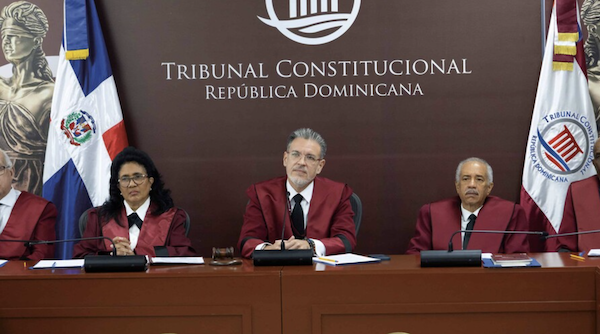
The Constitutional Court (TC) has issued a series of rulings reiterating that it is not a venue for reviewing facts, weighing evidence, or reopening closed litigation. The court, now under new leadership, is pushing back against a recurring pattern of legal appeals attempting to use the high court as a “fourth instance” of appeal for ordinary legal matters, Diario Libre reports in its coverage of recent rulings.
In dozens of recent rulings, the TC has insisted that its function is strictly limited to constitutional control and does not extend to the merits of individual cases.
Limits of constitutional jurisdiction
In ruling TC/0489/24, the judges, including Eunisis Vásquez, Miguel A. Valera, and Domingo A. Gil, clarified that cases lack constitutional relevance when the resolution requires the TC to intervene in “matters of ordinary legality” or to “re-evaluate the criteria applied by ordinary justice.”
The court warned that the nature of a constitutional appeal is lost when litigants attempt to use it to:
• Correct the application of ordinary law.
• Reinterpret judicial decisions already finalized by lower courts.
According to Organic Law 137-11, constitutional review is only admissible when the alleged violation is directly attributable to a judicial decision, “independent of the facts that gave rise to the process… which the TC cannot review.”
Strategic litigation vs. lack of training
Former TC judge Rafael Díaz Filpo told Diario Libre that this phenomenon could be attributed to both gaps in legal education and questionable litigation strategies. “It may be that some lawyers do not correctly handle the subject matter the TC oversees, or it could be a strategy to send it to the court knowing perfectly well it will be declared inadmissible,” Díaz Filpo noted, adding that the practice is professionally improper.
Despite the influx of these inadmissible appeals, Díaz Filpo stated that the court’s capacity is not compromised. He noted that the tribunal is obligated to respond to every instance submitted and has “religiously ruled on each of the resources” brought before it.
The role of the Constitutional Court
Under Article 184 of the Constitution, the TC’s mission is to “guarantee the supremacy of the Constitution, the defense of the constitutional order, and the protection of fundamental rights.” Under Law 137-11, the tribunal does not substitute for trial judges or act as an additional step in the standard judicial process.
Read more in Spanish:
Diario Libre
18 March 2026