

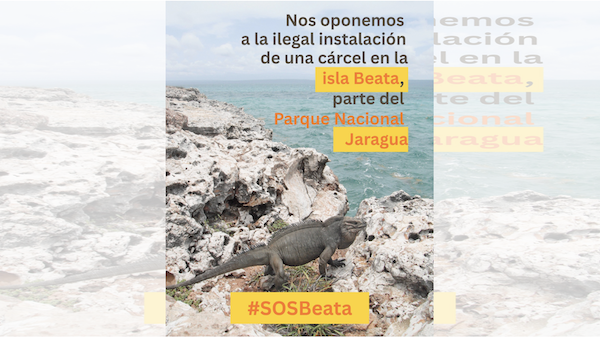
The Coalition for the Defense of Protected Areas issued a firm warning on 18 March 2026, rejecting a legislative proposal to construct a high-security penitentiary on Beata Island. The coalition characterized the project as a “flagrant environmental crime” and an “outrage” against the Dominican Republic’s conservation system. The project for the 10,000-inmate jail on Beata had received a favorable report from the Permanent Commission of the Public Ministry on 26 November 2025.
The proposal, which appeared on the agenda of the Chamber of Deputies’ ordinary session (No. 00006) on 18 March 2026, seeks to request that the Executive Branch establish a “model” prison on the island. The proposal was originally introduced on 21 June 2022 by deputies Elías Wessin Chávez (National District), Miguel Alberto Bogaert Marra (Santo Domingo), and Miguel Ángel de los Santos (National Deputy). The proposed jail would become the largest in the Dominican Republic. It would be reserved for individuals serving sentences exceeding five years.
The reenactment of the bill proposal is likely to meet with opposition from the Abinader administration. The current head of the Penitentiary and Correctional Services Agency (DGSPC) is Roberto Santana Sanchez, who has been openly against the construction of mega jails. He was appointed to the position on 1 October 2025. He is a renowned international specialist in prison reform and was the primary architect of modern jails with productive activities for inmates.
Environmental and legal concerns
Beata Island is a 27-square-kilometer ecosystem located off the southernmost tip of Pedernales province. Conservationists argue the plan is legally and ecologically non-viable for the following reasons:
• Protected status: The entire island sits within the boundaries of Jaragua National Park, a strategic and fragile ecosystem.
• Legal conflict: Under Dominican law, the land use required for a massive prison facility directly contradicts the legal mandate to safeguard natural resources and ecosystem services within national parks.
• Policy inconsistency: The Coalition noted that the proposal clashes with recent government commitments to strengthen the protection of the country’s natural heritage.
“The Dominican society will not allow, under any circumstances, this assault on our protected areas system to be consummated,” the Coalition stated in a press release. The group has called upon the Executive Branch, fellow legislators, and the general public to join in a unified rejection of the measure.
The Caribbean Sea is rough at this southwestern point of the Dominican territory, making access to the island difficult. Currently, Beata Island (Isla Beata) remains one of the most remote and least-developed areas of the Dominican Republic. It serves primarily as a strategic military outpost and a temporary base for artisanal fishermen, while also becoming a focal point for major new marine conservation efforts.
The island is technically uninhabited by permanent civilians, but it maintains a constant official presence. There is a permanent Navy detachment and a concrete outpost on the island. Personnel rotate regularly to monitor the territorial waters and provide security. Given its location near the maritime border and the Beata Ridge, the island is a critical point for surveillance and counter-narcotics operations.
Small groups of fishermen from mainland Pedernales and Enriquillo live on the island for weeks at a time. They stay in basic, “ultra-shabby” huts made of wood and corrugated metal along the shoreline. These local fishermen are the primary human presence outside of the military, focusing on the capture of queen conch (Lambis gigas) and spiny lobster.
Beata is part of the Jaragua National Park and is characterized by its “dogtooth” limestone (diente de perro) and xeric forests. The island is a major habitat for these large lizards, which are notably more relaxed around humans here than on the mainland. The island is also home to the Beata Skink and the Least Pauraque (a bird species).
The surrounding waters are now part of the Orlando Jorge Mera Marine Sanctuary, a massive protected area covering over 54,759 square meters.
Beata is not a “tourist destination” in the traditional sense. There are no hotels, restaurants, or paved roads. Reaching the island requires a good-sized sturdy boat or a specialized excursion from Cabo Rojo or Las Cuevas, typically a 1.5 to 3-hour journey depending on sea conditions.
Visitors report stunning, pristine beaches but warn of rough seas and a lack of facilities. Recent travelers have also noted challenges with floating plastic waste brought in by Caribbean currents, prompting local “clean-up” calls.
Read more in Spanish:
Listin Diario
Listin Diario
19 March 2026