

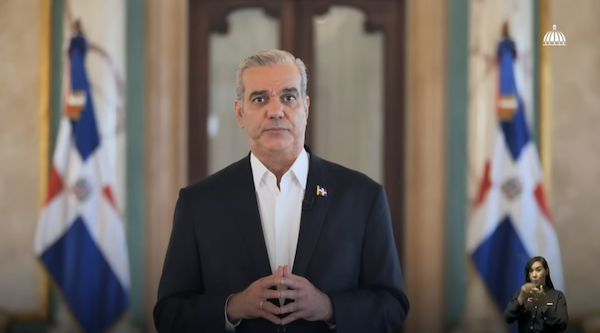
President Luis Abinader addressed the nation on Sunday, 22 March 2026, warning of inevitable continued price hikes in electricity, transportation, and food. He attributed these pressures to the “large-scale external shock” caused by the conflict in the Middle East involving Iran. He made the statements before leaving for a three day trip to France, where he will be meeting with French President Macron.
The President emphasized that the Dominican economy is bolstered by international reserves exceeding US$16 billion, robust liquidity, and reliable access to international financing. These fiscal buffers, he noted, allow the government to anticipate potential shocks and act decisively in response to any global or domestic contingencies.
The government highlights the figure of US$16 billion in reserves is a critical metric for economic stability, especially during the current global energy crisis. For context, these reserves typically cover approximately five to six months of imports, providing a vital “shield” against the currency volatility affecting other emerging markets.
Meanwhile, to mitigate the impact of rising oil prices, the government has identified approximately RD$10,000 million (US$169 million) from non-priority budget areas. These funds will be redirected to strengthen social programs and maintain a subsidy on fertilizers to protect food security.
President Abinader said the measures are directed to guarantee macroeconomic, fiscal and social stability in the country given the new international circumstances.
Minister of Economy and Hacienda, economist Magin Diaz had already explained the situation along these same lines.
Two fuel price hikes have impacted consumers already, adding RD$15 to diesel and gasoline prices. For the Week of 14–20 March, prices rose by RD$5 per gallon. And then for the Week of 21-27 March, prices rose by an additional RD$10 per gallon. President Abinader urged companies to adopt teleworking (remote work) to reduce fuel consumption.
The government had budgeted fuel prices of around US$65 the barrel for 2026, and now is seeing prices of upwards of US$100. The government, nevertheless, has kept unchanged the price of Liquefied Petroleum Gas (LPG), used for cooking and in many vehicles. Liquefied Petroleum Gas (LPG) and Natural Gas have remained frozen at RD$137.20 and RD$43.97, respectively, throughout the entire 30-day period.
There are already reports of price increases and difficulties in supplies imported from countries such as India. In recent years, India has been increasing its exports to the Dominican Republic. While India is not a combatant, it is currently emerging as one of the most severely impacted nations due to its extreme reliance on Middle Eastern energy and shipping. India imports nearly 90% of its crude oil and roughly half of that passes through the Strait of Hormuz. Following the blockade on 4 March, Brent Crude surged to US$120 per barrel.
Moreover, the conflict has halted nitrogen fertilizer exports. Urea prices jumped from US$425 to over $600 per ton. Analysts warn that a sustained 10% rise in food prices could push 30 million Indians into extreme poverty.
The closure of the Strait of Hormuz has removed approximately 20% of global oil and 20% of Liquified Natural Gas (LNG) from the market. The Dominican Republic imports most of its natural gas from the United States. “Our country imports all of its fuel, which means international prices inevitably impact the economy. However, we are prepared to face this situation and protect our people,” President Abinader assured.
President Abinader said that actions to diversity the electricity matrix are proving their worth. He mentioned recent advancements in the energy sector, including the consolidation of the diversifying of the energy matrix, the fixing of coal prices at Punta Catalina, and natural gas contracts secured for one year are actions already taken that minimize pressure on the population of the Iran War.
Finally, the President called for shared responsibility and citizen trust, emphasizing that the economic history of the Dominican Republic demonstrates its capacity for adaptation and resilience, and that the Government will act with firmness and planning to maintain the stability and direction of the country.
Read more:
Presidency
Diario Libre
Diario Libre
N Digital
N Digital
N Digital
N Digital
N Digital
Noticias SIN
The Guardian
23 March 2026