

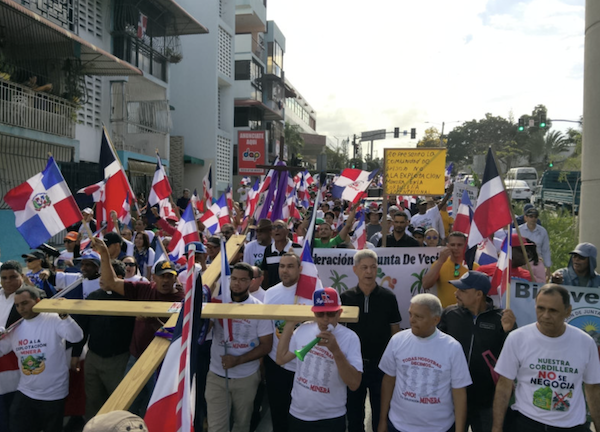
A diverse coalition of priests, environmentalists, and rural community leaders took to the streets of Santiago on Tuesday, 24 March 2026, to denounce the government’s “opaque” mining policies and protest potential extraction projects in the Cordillera Septentrional (Northern Mountain Range).
The demonstration, which began at the Santiago city center Monument to the Heroes of the Restoration, highlighted a growing rift between official government discourse and ongoing exploration activities in one of the country’s most ecologically sensitive regions.
High-stakes environmental warnings
Marching through the city’s main roads, including Las Carreras and Calle Del Sol, protesters carried crosses and Dominican flags to symbolize their defense of national resources. The march culminated in a civic vigil in front of the Provincial Governor’s Office, where leaders delivered a formal demand for transparency.
Key figures in the movement warned of large-scale environmental degradation if mining permits are finalized. Father Ramón (Niño) Ramos asserted that mining initiatives in the area put at least 300 rivers at risk, potentially depriving more than 80 communities of water between Santiago and Puerto Plata. Father Ramos clarified that the threat is not limited to a single project but involves multiple companies holding various concessions across the mountain range.
Environmentalist Nelson Estrella pointed to existing contamination at the Hatillo Dam as a cautionary tale, arguing that the government continues to push extractive projects without rigorous environmental controls.
A central theme of the protest was the perceived lack of honesty from the central government. Religious leaders criticized what they called “official contradictions,” noting that while the administration publicly claims it has no interest in exploitation, the technical processes for mineral exploration continue unabated.
“It has been said there is no interest in mining, yet the exploration processes continue,” Father Ramos stated, questioning the coherence of the Executive Branch’s actions.
Demands for social consultation
Father Rogelio Cruz, a prominent figure in Dominican social activism, launched a sharp critique against the political class, accusing officials of acting behind the backs of the citizenry.
“Natural resources are not the property of the state; they belong to the Dominican people,” Cruz declared. He insisted that any exploration or concession must undergo a prior consultation process with the affected communities. “Decisions cannot continue to be made without listening to the people. We already have clear examples of what happens when the country is handed over without considering its population.”
The protest reflects a climate of deepening social mistrust as communities demand concrete explanations regarding the number of concessions granted and the long-term environmental impact on the Northern Mountain Range.
Official status of mining in the Cordillera Septentrional
Despite recent government assurances that “no exploitation plans exist,” official records from March 2026 confirm that the state has granted several active exploration permits in the Northern region. These permits allow for technical and scientific studies (including drilling) but do not yet authorize commercial extraction.
The Ministry has identified three primary entities with active rights in the provinces of Santiago and Puerto Plata:
• Proyecto Minero Gold Rain (Lluvia de Oro): Holds exploration rights in several areas of the mountain range.
• Vertrixi Holding: Granted a concession in July 2024 to conduct geophysical and geochemical studies.
• Hispaniola Resources / Precipitate Gold: Actively exploring perimeters near the border of the Septentrional and Central ranges.
The current exploration permits cover a vast geographical area, which explains the high turnout of community leaders from both provinces. The specifically mentioned zones in the DGM database include:
• Santiago province: Pedro García, San Francisco de Jacagua, Palo Alto, Salamanca, and Piche.
• Puerto Plata province: Yásica Arriba, Yásica Abajo, Tubagua, Altamira, and Guananico.
Discrepancy fueling the protests
The “opacity” cited by Father Rogelio Cruz and Father Ramos stems from a technical loophole in Dominican law:
Exploration vs. Exploitation: The Government (via Minister Joel Santos) correctly states there are no exploitation (extraction) contracts.
Right of first refusal: However, under Article 42 of the Mining Law, a company that successfully completes exploration has the exclusive right to apply for an exploitation permit.
Protesters argue that once millions of dollars are invested in exploration, the pressure on the State to grant the final extraction permit becomes nearly impossible to resist, threatening the 300 rivers mentioned in the march.
Alicia Ortega dedicated a recent investigative report to the impact of mining on the Hatillo Dam.
President Luis Abinader traveled to France this week when he attended an Organisation for Economic Co-operation and Development (OECD) event that included the signing of a memorandum of understanding to increase Dominican government participation in contracted mining exploitation revenues.
Follow the story:
Listin Diario
El Informe con Alicia Ortega
25 March 2026