

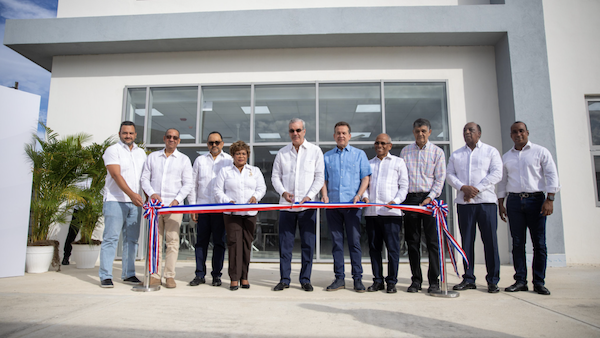
On 29 March 2026, President Luis Abinader inaugurated the new RD$117 million administrative headquarters for the Metropolitan Bus Services Operator (OMSA) in Santo Domingo West. Located on Prolongación 27 de Febrero, the 1,400 square meter three-level facility is a cornerstone of the government’s current initiative to modernize the state-run transport entity.
During the ceremony, officials outlined the broader “transformation” of OMSA, which includes the integration of 200 new buses into the fleet. The new buses come with a new branding. The Abinader administration has said the goal is to elevate Santo Domingo’s public transport system to the level of major regional cities. The buses enable metro commuters to continue their routes with the same pass.
The government also confirmed a strategic shift toward electromobility, incorporating electric units to improve the passenger experience while reducing the environmental impact of the city’s transit network.
Key features of the new OMSA headquarters
The building houses the new Control and Oversight Center, which is part of a structural transformation that began seven months ago to improve service quality. According to OMSA Executive Vice President Onésimo González, the new center will allow for:
• Real-time monitoring: Enhanced oversight of the bus fleet to ensure schedule adherence.
• Improved efficiency: Technologies aimed at reducing passenger wait times at bus stops.
• Staff dignity: A modernized workspace for public servants.
Strategic expansion and electromobility
The modernization of the Metropolitan Bus Services (OMSA) is a focal point of the current administration’s 2026 infrastructure agenda. Beyond the new administrative headquarters, OMSA is executing its multi-phase fleet expansion designed to integrate with the Santo Domingo Metro services.
Details on the 200-bus fleet expansion
The integration of 200 new diesel units is the primary objective of “Phase 1” of the 2026 OMSA Transformation Plan, scheduled for rollout between February and August 2026. These buses are specifically configured to meet high-capacity urban demands:
• Capacity: Each unit is designed to transport 90 passengers.
• Technology: All units are equipped with GPS for real-time tracking via the new Control and Oversight Center and support 100% electronic payment.
• Phased rollout: This fleet is distinct from the 200 electric buses planned for “Phase 2” (March–October 2026) and the 100 recovered units being deployed in the “Early Phase” (April–May 2026).
Priority routes and corridor integration
The new fleet will primarily reinforce existing high-traffic corridors while acting as a bridge for the expanded mass transit system. The confirmed coverage areas include:
Metro Line 2C feeder: New units will serve as “rutas alimentadoras” (feeder routes) for the extension of Metro Line 2C in Los Alcarrizos.
27 de Febrero Oeste: Identified as the first “Reformed Corridor” to receive full technological and fleet upgrades to reduce wait times to 5–7 minutes.
Santo Domingo West: Strategic deployment to support the “Judicial City” area
Santiago: A portion of the new fleet is earmarked for Santiago de los Caballeros to feed the Teleférico and Monoriel systems.
The construction of the new administrative building was part of a strategic land-swap agreement between OMSA and the Ministry of Housing and Buildings (Mived).
To facilitate the development of the Santo Domingo West Judicial City, a massive 13,865-square-meter complex under construction, OMSA ceded a significant portion of its existing grounds on Prolongación 27 de Febrero.
Details of the agreement
The project was structured as a “quid pro quo” to modernize institutional infrastructure in the municipality without the need for additional land acquisitions:
• The swap: OMSA provided the land required for the Judicial City (which is now 55% complete). In exchange, Mived took responsibility for constructing the new, modern three-story headquarters that President Abinader inaugurated this past Sunday.
• The investment: The RD$117 million spent on the new OMSA building was essentially the “repayment” for the ceded land, ensuring the transport entity received a high-tech facility (including the new Control and Oversight Center) to replace its older, less efficient space.
• Wider infrastructure impact: This agreement also included the construction of the Módulo C-1 of OMSA in Los Alcarrizos (located on OMSA land near the Teleférico) and the recent total renovation of Módulo C-4 on John F. Kennedy Avenue, which was delivered in mid-2025 as part of the same inter-institutional cooperation.
Read more in Spanish:
Presidency
Listin Diario
30 March 2026