

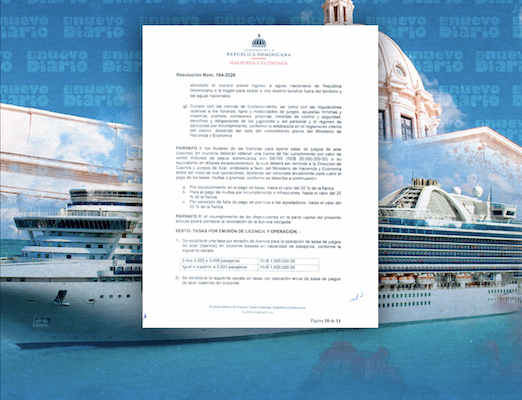
The Dominican government, acting through the Ministry of Hacienda and Economy, has issued Resolution 164-2026. requiring all cruise ships operating casinos or gambling halls within Dominican territorial waters to obtain an official license. Under the new regulatory framework, licensing fees for these maritime gaming operations are tiered based on vessel capacity, reaching up to RD$1.5 million.
The government seeks new revenues from the floating casinos that dock at the Amber Cove, Taino Bay ports in Puerto Plata, the Casa de Campo Port in La Romana and off Catalina Island, and the Cabo Rojo Port in Pedernales, the Sans Souci Port in Santo Domingo and the Samana Port that will open in Samana in November 2026.
The resolution establishes the legal framework for “first-class cruise ships” to operate gambling halls while in Dominican waters. As noted in your draft, the fees are set at:
• RD$1,000,000.00 for ships with 2,000 to 3,499 passengers.
• RD$1,500,000.00 for ships with 3,500 or more passengers.
The enforcement of these licenses includes mandatory adherence to Resolution 217-2025, which focuses on the Prevention of Money Laundering and Terrorist Financing specifically for entities supervised by the Directorate of Casinos.
Strategic oversight and compliance
The measure is designed to integrate shipboard gaming into the national legal framework, specifically targeting “first-class cruise ships” that dock in Dominican ports, anchor in national bays, or navigate through territorial waters. Beyond revenue collection, the regulation mandates rigorous financial oversight to align with international standards.
Key compliance requirements include:
• Anti-Money Laundering (AML): Operators must implement specific controls and procedures to prevent money laundering and the financing of terrorism.
• Restricted Access: Gaming services are strictly delimited to tourists on board while the vessel is within the jurisdiction of the Dominican Republic.
• Regulatory Monitoring: Operations remain subject to financial audits and inspections by the Ministry of Hacienda (Finance and Economy).
The Abinader administration has encouraged the opening of the terminals for boosting maritime tourism. By formalizing the casino operations, the government aims to ensure that the “blue economy” contributes to the national treasury while maintaining high standards of transparency and security within the gambling industry.
Read more in Spanish:
El Nuevo Diario
8 April 2026