

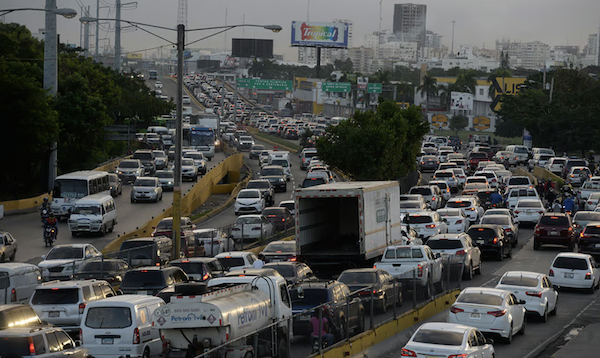
The authors of a study of air pollution in Santo Domingo published in Atmosphere are warning of the high levels of heavy metals generated mainly by the traffic jams in Greater Santo Domingo.
The authors emphasize that this study fills a major gap in Caribbean environmental research. They call for the Dominican government to strengthen environmental monitoring systems and move toward more rigorous emission control policies to mitigate health risks for the residents of Santo Domingo. The study dates back to 2022, thus if the study were to be updated in 2026, the findings would likely be worse because traffic and industry has intensified.
The researchers warn that because these metals are bound to respirable particles, they pose a severe risk to the population. Prolonged exposure to these elements is linked to respiratory and cardiovascular diseases, neurological damage, cytotoxic effects and various forms of cancer.
The pioneering study identified vehicular traffic and industrial activity as the primary drivers of pollution. Titled “Heavy Metal Concentrations in Particulate Matter: A Case Study from Santo Domingo, Dominican Republic, 2022,” the research provides the first systematic analysis of atmospheric heavy metals in the nation’s capital, offering critical baseline data for urban air quality management.
Technical scope and methodology
The research was a collaborative effort between scientists from the Autonomous University of Santo Domingo (UASD), the Instituto Tecnológico de Santo Domingo (INTEC), and the Universidad Tecnológica de La Habana in Cuba. The research team included Carime Matos-Espinosa, Ramón Delanoy, Anel Hernández-Garcés, Ulises Jáuregui-Haza, and José-Ramón Martínez-Batlle.
To ensure statistical rigor, the team analyzed thirty 24-hour air samples collected during 2022 across 30 representative urban locations. Using portable low-volume samplers and energy-dispersive X-ray fluorescence, they quantified the presence of ten specific metals – arsenic (As), Cadmium (Cd), Chromium (Cr), Copper (Cu), Iron (Fe), Manganese (Mn), Nickel (Ni), Lead (Pb), Vanadium (V) and Zinc (Zn).
The study evaluated both fine and coarse particulate matter, which are small enough to be inhaled deep into the lungs. The key findings, sources and pollutants revealed are:
• Dominant metals: Copper and zinc registered the highest mean concentrations. These are largely attributed to mechanical wear and tear from vehicles, such as brake pad erosion and tire friction.
• Industrial influence: Elements like vanadium and iron showed high spatial variability, pointing toward heavy fuel combustion and specific industrial processes in localized areas of the city.
• Source attribution: Through principal component analysis, the researchers confirmed that vehicular traffic and industrial activities are the dominant anthropogenic (human-caused) sources of heavy metal pollution in the city.
Read more:
Atmosphere (MDPI)
N Digital
8 April 2026