

Covid-19 Bulletin #585 reflects a spike in cases primarily in the northwestern provinces, Haitian border provinces, Santiago and Greater Santo Domingo. The good news is cases in Montecristi and Valverde are down, confirming for the second day that the regional outbreak could be under control.
Notwithstanding, overall the announcement that the two doses of Covid-19 vaccination are now required to use public transport has motivated many to get vaccinated. The daily number of vaccines administered jumped from a low 20,797 on 30 September 2021 to 83,745 doses for the 22 October 2021 deadline. The number of vaccinated, nevertheless, has again begun to gradually slide. Meanwhile, there is an increase in demand for PCR diagnostic tests.
Around 60% of the adult population is already fully vaccinated in the Dominican Republic, but the government has vaccine stocks for 100%+ and wants more people to get the jab.
The vaccines have spared the population a major spike in Covid-19 cases even with the entry of more aggressive variants. The Presidency has removed curfew restrictions nationwide and the new measures seek to motivate those that have not been vaccinated to get with it.
As of 18 October 2021, the government is requiring physical or digital proof that people be fully vaccinated for entering government offices, public transport and schools. The government said those that apply their first dose in October will be allowed to enter the public spaces and use public transport.
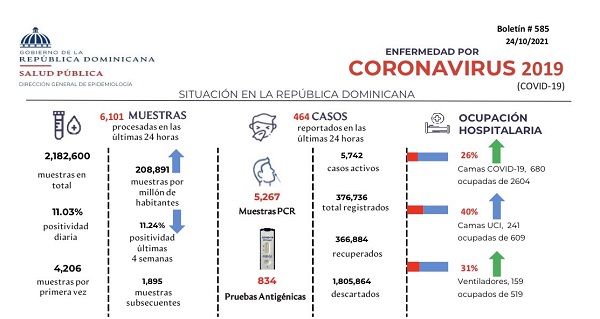
The Ministry of Public Health Coronavirus Bulletin #585 reports 464 new cases, down from 727 the previous day. The most cases are in Santiago followed by Greater Santo Domingo (the National District and Santo Domingo province).
The national 4-week positivity rate for the 24 October 2021 Epidemiological Bulletin #585 is at 11.47%. The 24-hour positivity for the day is 11.03%. Both 4-week and 24-hour positivity rates are down from the previous day.
Seventeen provinces and the National District present a positivity rate over 10%, reflecting the new spread that reaches more than half of the country’s provinces. The positivity rates over 10% in descending order are Pedernales 30.78%, Peravia 27.43%, Montecristi 21.17%, Santiago Rodríguez 17.97%, La Altagracia 17.71%, Dajabón 16.82%, La Vega 16.59%, El Seibo 15.97%, La Romana 14.11%, Azua 13.59%, National District 12.00%, San Pedro de Macorís 11.68%, San Cristóbal 11.19%, Valverde 10.93%, Santiago 10.55%, Sánchez Ramírez 10.31%, San Juan de la Maguana 10.27%, Santo Domingo 10.13% and Puerto Plata 10.00%.
The authorities are tackling the rise in cases with new efforts to override resistance to vaccination in many population groups that allege religious reasons and among others who distrust the vaccines or have just not taken the time to get vaccinated. The authorities seek to disavow the counsel of evangelical pastors and Roman Catholic priests who are known to strongly discourage vaccinating among their followers. Hundreds of thousands of Haitians that live in the Dominican Republic have also rejected getting vaccinated for cultural and religious reasons.
The goal is that at least 70% of the adult population be fully vaccinated. The authorities say the vaccines have protected people that catch the disease from being hospitalized. Death numbers and hospitalizations continue to be under control despite the recent surge in cases.
The 464 new cases for bulletin #585 compare to the 7-day nationwide average for confirmed cases that is 757, down from the previous day. Back to school, opening of night time entertainment centers, removal of curfew and circulation restrictions bring people together and serve to spread Covid. This is in addition to the circulation of the variants, including Gamma, Alpha, Delta and Mu. The government is also concerned of the impact the elimination of the curfew nationwide and the upcoming winter baseball professional championship will have on the spread of Covid-19 as of 27 October 2021.
The Ministry of Public Health’s Epidemiology Department Coronavirus Bulletin #585 reports active Covid-cases are 5,742,6,055, down (-313) from the previous day. The number of cases is considerably less than the peak 55,773 active cases registered in July 2020 and is evidence the vaccines are working.
As per Bulletin #585, with the deadline of 24 October 2021, the Ministry of Public Health has registered 376,736 confirmed cases since the first case on 1 March 2020. Labs carried out 5,478 first-time tests. This number of tests compares with the 14-day average now at 5,078.
The Ministry of Public Health is monitoring the new variants and their impact in the Dominican Republic as curfew restrictions are reduced to a minimum. The Ministry says unvaccinated people are driving the spread of the disease.
The Ministry of Public Health is closely monitoring the situation now that circulation restrictions that were part of the National State of Emergency were removed on 11 October 2021.
The government is betting on getting more people vaccinated. While there is an increase in cases, the death rate and hospitalizations continue under control. The government says that around 60% of the population is fully vaccinated and this apparently is containing the spread of the virus now that new variants are in circulation.
In its vaccination bulletin with data for the 19 October 2021 deadline, the Ministry of Public Health reports a significant change in the percentages of population with two doses of Covid-19 vaccine. The average is up from 57.84% for the 10 October bulletin to 60.01% for the 19 October bulletin. See the individual percentages now and for the 10 October previous bulletin:
La Altagracia (Punta Cana) – 91.8% (89.6%)
National District – 87.8% (84.5%)
Pedernales – 75.1% (73.8%)
Espaillat (Moca) – 68.0% (66.9%)
Puerto Plata – 66.7% (65.2%)
San Pedro de Macorís (Juan Dolio) – 64.3% (62.3%)
La Romana – 64.6% (61.7%)
Independencia – 60.9% (60.1%)
Sánchez Ramírez (Cotuí) – 60.5% (59.3%)
Barahona – 59.1% (58.2%)
San José de Ocoa – 58.9% (57.9%)
Dajabón – 58.8% (57.6%)
Baoruco – 57.9% (57.0%)
Monte Plata – 57.7% (56.3%)
San Juan de la Maguana – 57.4% (56.7%)
Valverde – 55.8% (55.0%)
Santiago Rodríguez – 55.6% (54.2%)
Montecristi – 55.5% (54.3%)
El Seibo –55.1% (53.6%)
Azua – 54.5% (53.6%)
Hato Mayor – 54.9% (53.2%)
Peravia (Baní) – 54.2% (52.8%)
Santiago – 53.9% (52.3%)
Samaná – 53.8% (52.2%)
Santo Domingo – 52.8% (50.8%)
Hermanas Mirabal – 52.7% (51.6%)
Elías Piña – 52.1% (50.5%)
María Trinidad Sánchez (Nagua) – 51.8% (50.9%)
Duarte (San Francisco de Macorís) – 51.7% (50.5%)
La Vega – 51.4% (50.0%)
San Cristóbal – 51.2% (49.0%)
Monseñor Nouel (Bonao) – 50.7% (49.3%)
Decree 622-21 removed the curfew. Yet the Ministry of Public Health issued Resolution #048 that mandates vaccines for those older than 12 years and maintains a ban on the sale of alcoholic beverages from 12 midnight to 5am nationwide.
Ministry of Public Health permits continue to be required for events where people agglomerate and public places and private places for public use are limited to 75% of capacity.
The general vaccination drive is open to persons 12+ years old since Saturday, 12 June 2021 with the arrival of Pfizer vaccines to select vaccination centers. As of 2 July 2021, a third Pfizer booster shot has been available for adults.
For the 24 October deadline, Our World in Data reports that 80,133 first and second dose vaccines were applied, a significant increase over the previous day, and a new recent high since 3 August 2021. The record vaccinations for one day was 184,208 on 10 June 2021. The rolling 7-day average as of 24 October 2021 deadline is now at 77,797 vaccines applied per day. The number of vaccines applied had been on the rise from 9 October to 22 October.
The VacunateRD government website reports injecting 6,623,121 first doses of the vaccine and 5,253,400 second doses for the 24 October 2021 vaccination deadline.
The National Vaccination Plan recommends a booster shot different from the first two doses to be applied a month after the second dose of the Sinovac vaccine and three months after the second dose of the AstraZeneca vaccine. The Pfizer booster vaccine is being applied to persons with co-morbidities and seniors, and at demand in select vaccination stations. For the 24 October 2021 deadline, the Ministry of Public Health had reported that 1,179,426 people had received the Pfizer third booster shot, mostly people older than 50 years.
By regional standards, the Dominican Republic has been relatively successful at treating Covid-19 and keeping the number of deaths low. For the 24 October 2021 deadline, Worldometer lists the 1M deaths per inhabitant rate for the Dominican Republic at 374. According to the same 1M deaths statistics, fewer people have died of Covid-19 in the Dominican Republic than in Brazil at 2,823, Argentina at 2,532, Colombia at 2,463, the United States at 2,268, Italy at 2,185, the United Kingdom at 2,042, Spain at 1,863, France at 1,794, Russia at 1,587, Germany 1,139 and Canada at 753, all major markets for Dominican tourism and countries with overall better health systems.
Two Covid-related deaths are recorded for the 24 October 2021 deadline. One death is reported having occurred in the previous 24 hours of the deadline. As of the 24 October 2021 deadline, 4,110 persons are reported to have died of the disease in the Dominican Republic, a nation of more than 10.8 million adults since March 2020. The fatality rate has been dropping and now is at 1.09%. The fatality rate per 1M inhabitants is 393.36. Dominican physicians’ diverse treatment for the disease has been relatively successful in the region. The Ministry of Public Health reports that the country’s 393.36 fatality rate per 1M compares favorably to the average 1M inhabitants’ fatality rate for the Americas at 2,190.36 as of 23 October 2021.
The Ministry of Public Health report #585 indicates 26% of Covid-19 hospital beds are occupied (680 of 2,604 total available), up from the previous day. 40% of the intensive care units for Covid-19 are taken (241 of 609), up from the day before. The hospitalization statistics are for all the country. Hospitalization demand in Greater Santo Domingo, Santiago and other major cities is much higher than the national average.
The past seven days bulletin result highlights are:
Bulletin #585: 376,736 confirmed cases, 464 new cases reported in the past 24 hours, 5,742 active cases, two deaths are reported for the deadline, and one death happened in the past 24 hours. The fatality rate per 1M is 393.36.
Bulletin #584: 376,272 confirmed cases, 727 new cases reported in the past 24 hours, 6,055 active cases, two deaths are reported for the deadline, and one death happened in the past 24 hours. The fatality rate per 1M is 393.17.
Bulletin #583: 375,545 confirmed cases, 823 new cases reported in the past 24 hours, 6,290 active cases, six deaths are reported for the deadline, and four deaths happened in the past 24 hours. The fatality rate per 1M is 392.98.
Bulletin #582: 374,722 confirmed cases, 793 new cases reported in the past 24 hours, 6,419 active cases, three deaths are reported for the deadline, and two deaths happened in the past 24 hours. The fatality rate per 1M is 392.40.
Bulletin #581: 373,929 confirmed cases, 889 new cases reported in the past 24 hours, 6,252 active cases, two deaths are reported for the deadline, and one death happened in the past 24 hours. The fatality rate per 1M is 392.11.
Bulletin #580: 373,040 confirmed cases, 963 new cases reported in the past 24 hours, 6,152 active cases, two deaths are reported for the deadline, and one death happened in the past 24 hours. The fatality rate per 1M is 391.92.
Bulletin #579: 372,077 confirmed cases, 630 new cases reported in the past 24 hours, 5,930 active cases, three deaths are reported for the deadline, and no deaths happened in the past 24 hours. The fatality rate per 1M is 391.71.
For the 24 October deadline, there were more than 10 cases reported in 11 of the Dominican provinces and the National District, down from 16 provinces last week. There were 83 cases in Santiago, 79 in the National District, 65 in Santo Domingo, 52 in Dajabón, 32 in Santiago Rodríguez, 29 in San Cristóbal, 27 in Puerto Plata, 17 in Monseñor Nouel, 15 in La Romana, 12 in Independencia and 10 in La Altagracia.
Greater Santo Domingo continues to lead in the number of reported PCR cases. As of 24 October 2021 at 6pm, the deadline for Bulletin #585, the most confirmed cases have been reported in the National District (99,010) and the Santo Domingo province (80,894). The numbers account for 50% of the 376,736 confirmed cases nationwide.
Province case totals are: Santiago (39,118), La Romana (13,553), La Altagracia (13,542), La Vega (13,050), San Cristóbal (12,970), Puerto Plata (10,282), Duarte (8,778), Espaillat (7,947), San Pedro de Macoris (6,277), San Juan de la Maguana (6,091), Barahona (4,932), Maria Trinidad Sánchez (4,759), Azua (4,705), Valverde (4,607), Monseñor Nouel (4,218), Sánchez Ramírez (4,050), Peravia (3,716), Hermanas Mirabal (3,513), Monte Plata (2,419), Montecristi (2,412), Santiago Rodriguez (2,197), Dajabón (2,179), Baoruco (2,043), Hato Mayor (1,809), Independencia (1,465), San José de Ocoa (1,458), Samaná (1,300), El Seibo (1,282), Pedernales (1,251) and Elías Piña (598) as of the 24 October 2021 deadline.
Public schools reopened for in-person learning on 20 September 2021. Many private schools opened for in-person learning before 1 September 2021. Schools continue to be subject to health protocols. Universities reopened for classes in August but require students and teachers to have the full vaccination dose. The Health Cabinet is reviewing the approval of vaccinating school children ages 5 to 11 years old.
The government seeks to vaccinate 7.8 million adults of the population of 10.8 million. The 7.8 million does not take into consideration those 12-18 years of age that of June 2021 are included in the vaccination campaign with the regular arrival of batches of Pfizer vaccines.
Regarding Covid-19 testing in the Dominican Republic, private labs have special facilities for those requiring results in time for travel abroad. Results of PCR tests can be had in 24 hours for those presenting a valid airline ticket at labs carried out the test in Santo Domingo, Santiago, Puerto Plata, La Romana and Punta Cana. Antigen tests results can be had in three hours at select labs in the same locations. Nevertheless, travelers are recommended to make arrangements with extra time. PCR test results are usually given in 24 hours or less online.
Canada and Spain are requiring all entering to show negative results of a PCR test carried out within 72 hours before the traveler’s scheduled departure to those countries. Yet, Spain has announced that travelers who have the two doses of the Sinovac or Pfizer vaccine at least two weeks before the travel date can enter without a PCR test. Both vaccines are now available in the Dominican Republic. Around 70% of those vaccinated in the Dominican Republic have received the Sinovac/Coronavac vaccine. The US requires travelers to show negative antigen or PCR test results taken within 72 hours of the arrival to US territory.
Open-air public spaces, such as parks and boulevards, can be used for activities other than social gatherings and always complying with preventive health protocols. Gyms, restaurants and bars are allowed to operate at 75% of their capacity. Theaters have resumed showings under health protocols.
Hotels and resorts have operated throughout the pandemic under previously established less restrictive health protocols. In July, the Ministry of Tourism authorized again booking up to 100% of room capacity. Booster shots have been made available to all hotel personnel as an extra step to ensure the safety of guests and staff alike.
The government began to vaccinate for the Covid-19 virus on 16 February 2021. As of 3 September 2021, the Dominican Republic had received 21,737,730 vaccine doses, of which around 72.77% have come from China – 15,768,000 Sinovac and 50,000 Sinopharm vaccines (15,818,000). Pfizer has delivered 5,530,530 vaccine doses for 20.84%. Of the AstraZeneca vaccine, the delivered 1,389,200 doses represent 6.39% of the total.
The last reported arrivals of vaccines was on 3 September 2021, when the Health Cabinet announced the arrival of a shipment of 180,180 Pfizer vaccines. The government has a surplus of vaccines. The Health Cabinet has not shared updates on new arrivals of vaccine stock. President Luis Abinader announced on 22 September 2021 speaking at the UN General Assembly that the Dominican Republic had donated 802,000 vaccines to neighboring countries. The Dominican Republic has also donated vaccines to Guatemala, Honduras and Costa Rica. The Abinader administration donated 101,000 doses to Honduras and 304,000 doses to Guatemala to boost their vaccination campaigns.
Free vaccines are available at more than 1,400 vaccination centers nationwide. The Pfizer vaccine is available at major vaccination sites. The Pfizer vaccine is also available as a booster shot for those who have received the two Sinovac or AstraZeneca vaccines and at demand for those who prefer this vaccine. It is also available for those who need the vaccine for travel purposes.
The Ministry of Public Health continues to mandate keeping to the preventive measures of mask-wearing, physical distancing in public spaces, hand hygiene and keeping to well-ventilated areas. In the cities, mask-wearing is the norm and is mandatory. As of recent weeks, mask usage has been relaxed in public areas. People are gathering in restaurants and bars without masks, and discos and theaters are again open. Shopping malls and major stores continue to require the use of the facial masks. Those attending sports and theater performances need to keep their masks on during the events.
Haiti is reported having 23,406 confirmed cases and 658 deaths, as per the 24 October 2021 global epidemiological deadline. Haiti has only just begun to start its Covid-19 vaccination program. This was because the Haitian government rejected a first Covax facility donation of AstraZeneca vaccines. The Dominican government authorized the vaccinating of Haitians with domicile in the Dominican Republic. A donation of Moderna vaccines was shipped to Haiti for the start of the vaccination program. As of 10 October 2021, 118,202 doses of Spikevax (Moderna) vaccines had been applied in Haiti at the 149 open vaccination centers since the start of vaccination on 16 July 2021. Haiti rejected a donation of 100,000 AstraZeneca vaccines from the Dominican Republic. Only 31,540 people are fully vaccinated (2 doses) in Haiti as of the 20 October 2021 data update.
Overall, health experts attribute the general low number of deaths in Haiti 57 per 1M pop compared to 374 per 1M in the DR) as of 24 October 2021 in part due to widespread vaccinating of babies with the tuberculosis vaccine and widespread use of ivermectin for parasites that have raised the immunity of the population. In-person education has continued regularly in Haiti, and most people do not wear masks nor exercise physical distancing.
In the Americas, the Dominican Republic is now ranked 19th in confirmed PCR cases after the United States, Brazil, Argentina, Colombia, Mexico, Peru, Chile, Canada, Ecuador, Bolivia, Paraguay, Panama, Cuba, Costa Rica, Uruguay, Guatemala, Venezuela and Honduras.
Read more:
Decree revoking National State of Emergency
Ministry of Public Health – Resolution #000048
See the Ministry of Public Health epidemiological
Bulletins
VacunateRD
John Hopkins Coronavirus Resource Center
University of Washington Health Data
University of Oxford Covid Tracker
Worldometer
Our World in Data
26 October 2021