

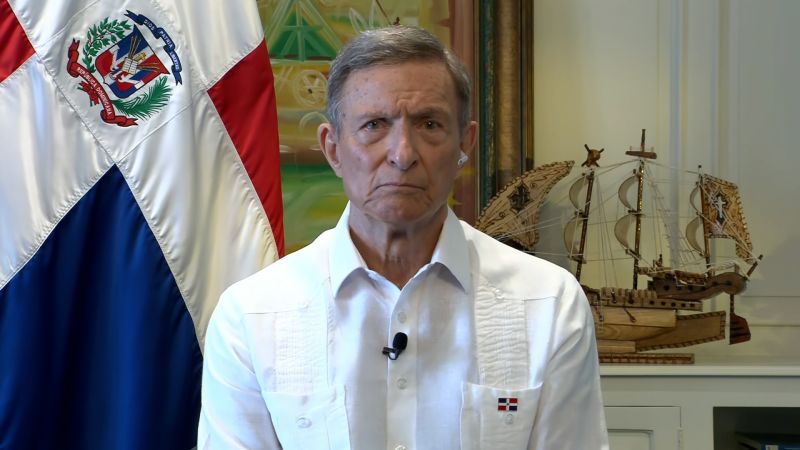
CNN crisis expert journalist, Christiane Amanpour interviewed Foreign Minister Roberto Alvarez on 19 March 2024.
During the interview, Alvarez said that he has been told that six members of the nine-member transitional presidential council have been designated by the political parties and institutions, including two observers.
Asked about increased controls to avoid exodus of Haitians into the DR, Alvarez said the Dominican Republic is a growing economy, one of the highest in Latin America. He explained: “This is a magnet to attract workers, Haitians since we share the island. Given the catastrophic situation in Haiti it is our national security that is at stake. We have had to reinforce our border, about 10,000 soldiers are at the border at a heavy cost, but it goes well beyond that.” He mentioned social services that are used by Haitian migrants in the Dominican Republic.
According to Alvarez, rapid stabilization in Haiti is important, not to mention the suffering of the Haitian people.
Amanpour said the gang leaders that are in control of an important part of Haiti have rejected the international intervention and UN-backed peace stabilization force, and asked Alvarez what is going to get the people in charge to accept.
Alvarez said that is why the Dominican Republic has been calling the attention of the international community since President Moise was assassinated in July 2021 on the need for assistance to the Haitian National Police before it was too late. “We are getting close to that point, it is a catastrophic situation in Haiti and although the gangs control probably about 80% of the territory of the capital. We still believe that with the level of assistance of an international mission with the participation of several countries, it can be gotten under control,” he said.
Alvarez explained: “A lot of gang members are unemployed youths that have nothing better to do. Some of them have been forced to join the gangs. We believe that a well-armed, assistance mission to the Haitian national Police can still get the situation under control.”
Christiane Amanpour pressed Alvarez on why the recent stabilization mission would make a difference from past missions that have just left the situation worse.
Alvarez said that armed interventions by themselves do not solve the Haitian problem or any country’s problem. He explained: “Only the Haitians themselves will. Eventually, the Haitians will have to pull themselves by their bootstraps. They are the only ones that can do it, but to get to that point, where there is a certain level of peace, security, some basic law and order, today international assistance is required. There is just no other way. The Haitians themselves have asked for it. 80% of the Haitian population, at least approves of it, because there have been polls with people stating they would live to have international assistance.”
Alvarez insisted: “The Haitian actors, themselves as stakeholders need to get together, develop a national plan, stick to it, or it will never work. Ultimately it is up to the Haitians themselves.”
Christian Amanpour asked about the Dominican role. She mentioned the reinforcing of the border to avoid exodus waves of people. She said UN sources indicate Haitian gangs use the country as a planning base to stash their money and said it is exacerbating the violence and instability and asked what the country is doing to stop that.
Alvarez responded: “I believe you are probably referring to the UN report from their agency on drugs and crime that says the DR has been used as a transit point for some arms and ammunition. We have not seen the proof of that allegation, we produce no arms in the Dominican Republic, and that report itself and most reports state that the arms are coming from the United States.”
Alvarez emphasized that one of the main aspects of the UN Security Council resolution on Haiti, in addition to calling for the assistance of the multinational force, is also asking for an arms embargo. He said the US authorities are working on it, but that most of the arms are coming from Florida and enter Haiti through their ports and airports, not from Dominican ports or airports. “You need to sanction the individuals, the politicians and others who have been over the years helping the gangs to grow, seeking political support. That is another aspect that is essential in the UN resolution to be fully applied,” said Alvarez.
Christiane Amanpour asked about the humanitarian crisis and asked what the DR is doing to facilitate the relief of the humanitarian disaster. Alvarez responded: “Along the border between the DR and Haiti there are multiple binational markets that operate every week, even now under these dire conditions. And those are the main areas where Haitians themselves purchase most of their food, water and other merchandise for everyday living in Haiti. Along the border of 391 km border and again these binational markets are in operation today. We have supplied different hospitals and embassies with fuel and other needs at different moments. We have in the past also been a transshipment point for a lot of humanitarian assistance.”
Alvarez highlighted: “At this point today the airport in Haiti is closed, so there is no way. You cannot even cross over the border because the gangs control the highways into Port au Prince. So, getting humanitarian assistance into Haiti today is one of the challenges.“
Follow the story:
CNN
20 March 2024