

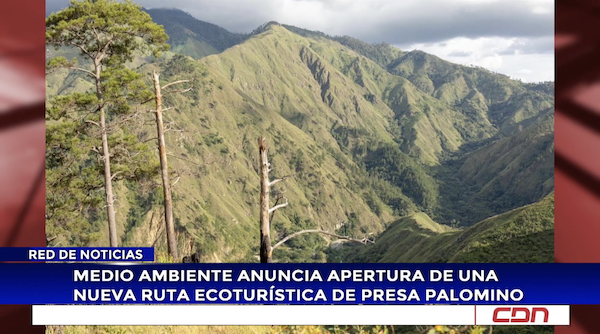
The Ministry of Environment has announced that a new ecotourism route at the Palomino Dam will officially open to the public on 21 January 2026.
The new trail is located within the José del Carmen Ramírez National Park in the mountainous municipality of Bohechio in San Juan de la Maguana. The trail is part of a strategic overhaul to enhance visitor safety and bolster conservation efforts. The move follows a significant surge in hiking and ecotourism activities in the region over the last five years.
The area is nestled in the southern flank of the Cordillera Central, the Caribbean’s highest mountain range. As part of the José del Carmen Ramírez National Park, it serves as a vital ecological corridor and a primary water source for the region.
Rules for visiting
To manage the environmental footprint of increased foot traffic, the Ministry, through the Vice-Ministry of Protected Areas and Biodiversity, has established strict guidelines for “overnight stays” (camping):
• Advance authorization: Groups must apply for permits via the Ministry’s digital platform at least 15 days in advance.
• Capacity limits: A maximum of 120 people per night is permitted in the designated temporary camping zone.
• Guided access: Every group must include at least one local guide for every 10 visitors. These guides will soon undergo certification as “nature interpretive guides.”
• Strict prohibitions: In compliance with Law 225-20, single-use plastics are banned. Visitors must use reusable utensils and carry out all solid waste. Additionally, alcohol, cigarettes, and vaping are strictly prohibited within the park.
Looking ahead, the Ministry plans to construct permanent facilities in the overnight zones to further mitigate environmental impact while supporting the local economy in Bohechío and surrounding San Juan communities.
The announcement of the new trail comes at a time when the Ministry of Environment has pending to make public whether it will grant exploitation rights to the GoldQuest gold mine exploration site.
The new Palomino Dam trail is located approximately 15 to 20 kms in a straight line from the GoldQuest Romero gold mine exploration site. The rugged mountainous terrain of the Central Cordillera makes travel between them significantly longer and more difficult by land.
Both sites are located in the San Juan province, north of the city of San Juan de la Maguana, within the same mountainous corridor.
Palomino Dam is located near the confluence of the Blanco and Yaque del Sur rivers, roughly 18–20 km northeast of San Juan de la Maguana. Likewise, the GoldQuest Romero Project is located near the community of Hondo Valle, approximately 35 km north of San Juan de la Maguana.
The GoldQuest Romero project is currently “held up” by a combination of high-level regulatory steps and significant local social opposition, though it recently cleared a major hurdle with the Ministry of Environment.
Last June 2025, the Ministry of Environment officially issued the Terms of Reference (ToR) for the project. This was a “pivotal step” because it gave GoldQuest the legal roadmap to conduct the final Environmental Impact Assessment (EIA). The firm Aecom was entrusted to lead the study which is expected to continue through early 2026. Wikipedia describes Aecom as an infrastructure consulting firm based in Dallas, Texas.
The actual authorization to mine cannot be granted until this study is finished, submitted, and then rigorously reviewed by the Ministry. GoldQuest announced in early January 2026 that it is completing a “Bankable Feasibility Study” (BFS), expected by the first half of 2026, to run alongside the environmental results.
Read more in Spanish:
Presidency
Ministry of Environment
Proactive Investors
GoldQuest
DR1 News
20 January 2026