

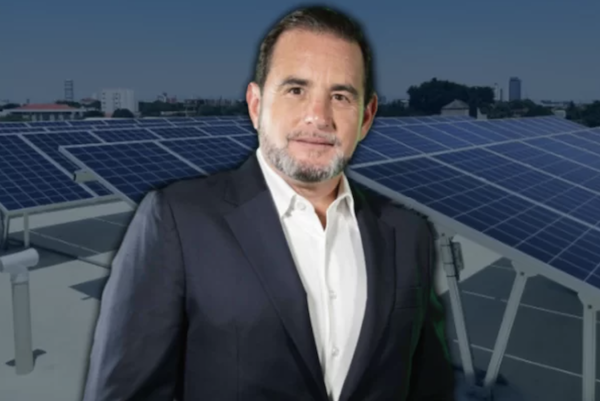
The new regulation governing distributed generation in the Dominican Republic was recently published on 19 January 2026, marking a significant shift in how solar panels are installed for residential and commercial use. Carlos Janáriz, president of the Association of Renewable Energy and Energy Efficiency Companies (Aseefer), has described this as a “considerable positive advance” that removes many of the bureaucratic barriers that previously hindered solar development.
In an interview for Esta Noche con Mariasela, Janariz spoke to the considerable reduction in red tape. The new rules aim to eliminate discretionary interpretations by utility companies. “Zero injection” systems (those that do not send energy back to the grid) no longer require formal permits. Users only need to submit technical designs and install anti-spill mechanisms.
Another measure in favor of consumers is that the ruling establishes that if a utility company does not respond to an interconnection request within 45 days, the project is now considered automatically approved. Evaluation times for other steps have been reduced from 45 days down to 10.
Likewise capacity caps are eliminated. Previous limits, such as 25 kW for residences and 1.5 MW for businesses, have been replaced by a criterion based on the user’s actual annual consumption. Additionally, the 15% solar penetration limit per circuit has been eliminated.
Bidirectional meters are now to be provided by the utility companies at no cost to the user. Furthermore, the regulation explicitly prohibits utilities from changing a customer’s electricity tariff simply because they installed solar panels.
Despite the overall positive outlook, experts point to the new charges for surplus energy. Users categorized as “monomic” (primarily residential and small business) must now pay a charge equivalent to 25% of the energy they inject into the grid. This is treated as a “toll” for using the distribution network.
The new ruling calls for a transition period. Existing solar users have a five-year transition window to migrate to the new regulatory framework.
The regulation applies to all electricity providers, including public distributors (EDEs), private companies, and isolated systems.
Follow the story in Spanish:
N Digital
Esta Noche con Mariasela
5 February 2026