

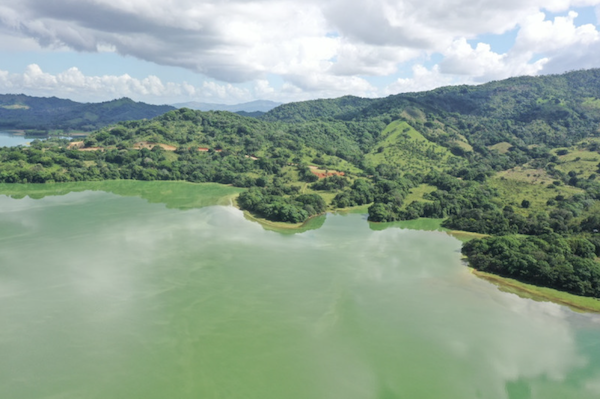
The Academy of Sciences of the Dominican Republic (ACRD) issued an urgent environmental alert on Monday, 16 February 2026 warning of severe degradation and toxic cyanobacteria blooms in the Hatillo Dam, the largest freshwater reservoir in the insular Caribbean.
Through its Commission for Natural Resources and Environment, the Academy reported a “drastic change” in water quality and coloration. The reservoir is currently blanketed by a thick, pasty green layer caused by a massive proliferation of Microcystis, a genus of cyanobacteria that poses a direct threat to the ecosystem and the populations relying on the basin.
Located in Cotuí, Sánchez Ramírez province, the Hatillo Dam is a cornerstone of Dominican national security. Sanchez Ramirez is the location of the Barrick Gold mining corporation with its large tailing reservoir. The company is building a second tailing reservoir.
Completed in 1984 with a capacity of 710 million cubic meters, the Hatillo Dam serves three critical functions:
• Flood control: Protecting the lower Yuna River basin.
• Agriculture: Irrigating over 2,200 hectares of farmland vital for food security.
• Energy: Generating 8 megawatts of clean hydroelectric power.
The Academy emphasized that the contamination does not stay confined to the reservoir. Because the Yuna River flows into Samaná Bay, the poor water quality threatens the mangroves of the Bajo Yuna, local fisheries, and the country’s world-renowned humpback whale-watching season.
Root causes of the decay
The ACRD identified a “cyclical” pattern of contamination driven by an excess of nutrients. Experts pointed to four primary catalysts for the current crisis:
• Agrochemical runoff: Intensive use of fertilizers in upstream farming.
• Organic waste: High levels of organic matter being washed into the reservoir.
• Climate factors: Reduced water levels during prolonged droughts.
• Mining activity: Discharges from mining operations in the surrounding areas.
Call for immediate intervention
Despite the dam’s location within the Aniana Vargas National Park, a protected area, the Academy notes that environmental regulations are not being sufficiently met.
The Commission has called for the immediate formation of a multidisciplinary task force to map the zone of influence and inventory all nearby industrial and agricultural activities. Their proposal includes a permanent monitoring system and a “characterization” of the physical and chemical pollutants currently present in the water.
“The protection of the Hatillo Dam is a national priority,” the ACRD stated, urging the government to move beyond temporary fixes toward a “structural and sustained” intervention to safeguard the nation’s most significant freshwater asset.
Read more in Spanish:
Listin Diario
Hoy
Academy of Sciences
17 February 2026