

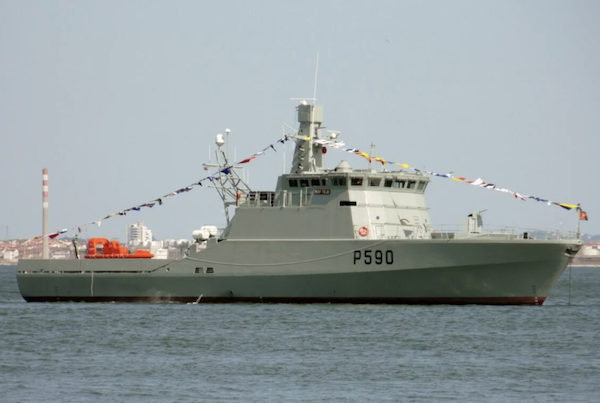
The Abinader administration announced the purchase of four Tejo-class coastal patrol vessels for the Dominican Navy. The equipment is promoted as essential to the patrolling of Dominican waters. The Dominican Republic is located in the center of the Caribbean a geographic position that makes it especially vulnerable to maritime crime and those who seek to use the country as a transshipment point.
President Luis Abinader has justified the acquisition as part of broader national security spending increases driven by external factors, including regional drug trafficking routes and cross-border criminal activity. The vessels will strengthen Dominican maritime security and counter drug trafficking operations in the Caribbean.
The Ministry of Defense is making the purchase for €24,000,000, or an individual price of six million euros. The purchase was reportedly first agreed upon during last year’s visit of President Luis Abinader to Portugal in May 2024. The Presidency did not reveal the details of the transaction and the terms for payment.
This is the most expensive miltary purchase since the days of the Super Tucano aircraft during the Leonel Fernandez administration.
As reported, the vessels were originally built between 30 and 40 years ago. Known as the Standard Flex 300 class of vessels, the Danish Navy sold five of these vessels to Portugal in 2010, including the four purchased by the Dominican government.
The Dominican purchase of these patrol craft is aimed at increasing the surveillance of the Caribbean waters and to protect Dominican sovereign marine interests.
A report online says the four units are very costly to operate. The military news Oumier YouTube channel acknowledges that the acquisition marks a significant capability leap for the Dominican Navy (Armada de República Dominicana) in its asymmetric war against drug cartels and cross-border crime in the Caribbean. However, Oumier points out that behind the affordable price tag lies a massive technical challenge, the high operational cost.
The website shares a video that analyzes the hidden logistical nightmare of the Tejo-class: the complex CODAG (Combined Diesel and Gas) propulsion system. It examines why operating General Electric LM500 gas turbines in a tropical environment could drain the Dominican defense budget and why maintenance might be the Achilles’ heel of this deal.
The transfer of NRP Tejo, NRP Douro, NRP Mondego, and NRP Guadiana follows approval on 17 February 2026 by the Portuguese Council of Chiefs of Staff and forms part of bilateral defense cooperation.
Army Recognition website analysis by Jérôme Brahy explains that a defining feature of the Tejo-class is the StanFlex modular system, which can be exchanged in approximately 48 hours, enabling role conversion between surveillance and pollution control, combat, mine countermeasures, minehunter, and minelayer tasks.
The vessels sold are NRP Tejo (P 590), NRP Douro (P 591), NRP Mondego (P 592), and NRP Guadiana (P 593).
As reported, the transfer takes place within the framework of defense cooperation and a Portuguese transfer program of war material to the Dominican Republic, following contacts with the Dominican Vice-Minister of Defense for Naval and Coastal Affairs, Vice-Admiral Ramón Gustavo Betances Hernández, aimed at strengthening Dominican naval capacity.
The authorization also covers optional contractual systems and equipment that, if fully exercised, may reach €24,370,000 in additional value.
The director-general of Armament and Defense Assets, António José de Morais Baptista, was delegated with the powers to complete the deal and oversee execution, and ensure compliance with fiscal obligations.
Read more:
Presidency
Army Recognition
Oumier
Diario Libre
23 February 2026