

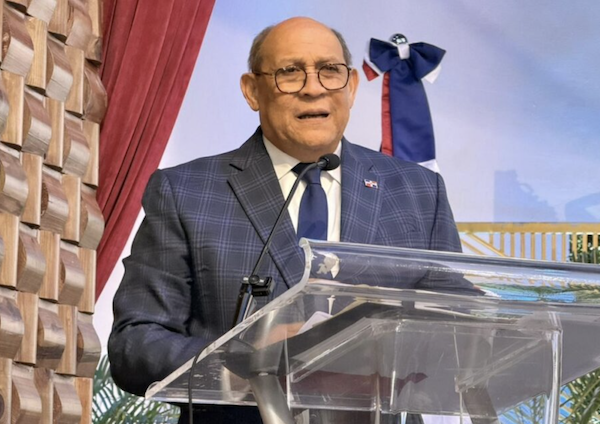
The newly appointed Minister of Higher Education, Science, and Technology (MESCYT), Rafael Santos Badía, has announced a significant pivot in the government’s plan to reform the educational sector. Instead of proceeding with the immediate merger of MESCYT and the Ministry of Education (MINERD), the Minister will request the National Congress to return the current proposal to allow for a broader “consensus table.” He plans to meet with former presidents (Leonel Fernández, Hipólito Mejía, and Danilo Medina) and business leaders (CONEP) to ensure the reform is a shared national vision.
He made the statements during an interview with TV program D’Agenda. Santos Badia had been director of the Infotep vocational school system of the government before his promotion.
The goal, according to Santos Badía, is to ensure the reform aligns with President Luis Abinader’s vision of a complete structural transformation rather than a simple administrative consolidation.
A new “Education Code” through consensus
The Minister outlined a multi-step process to redesign the Dominican educational system, emphasizing that he was appointed to “create, not destroy.” The proposed roadmap includes:
- Drafting a preliminary bill: Creating a robust initial document capable of undergoing significant modifications.
- Two-month public consultation: Opening platforms for citizens and stakeholders to contribute ideas, ensuring the process is not a “farce.”
- Expert review: Legal and educational experts will refine the bill based on public input.
- Final presentation: The revised draft will be shown to the consulted sectors before being sent to Congress via the Executive Branch as a new General Law of Education (effectively an “Education Code”).
Structural changes proposed
While the immediate merger is on hold, Santos Badía admitted that the eventual law might still restructure MESCYT. He suggested that Higher Education could transition into one or more specialized vice-ministries within a unified system.
He envisions a logical “government of education” categorized by planning and pedagogical services, quality control, student services and science and higher education.
“This logic is called the philosophy of education,” Santos Badía explained. “We must define how education and science will function in the era of the Fifth Industrial Revolution, establishing the relationship between humans, Artificial Intelligence, and robotics.”
The 4% funding debate
The Minister firmly rejected claims that the merger was a strategy to seize the 4% of GDP allocated to pre-university education to fund higher education. He argued that the focus should be on results rather than just the percentage of the budget. “The 4% can be a lot of resources for poor quality education,” the Minister stated, “but even 6% of GDP could be too little for an integrated educational system that delivers excellent results.”
Follow the story:
D’Agenda
El Dia
10 March 2026