

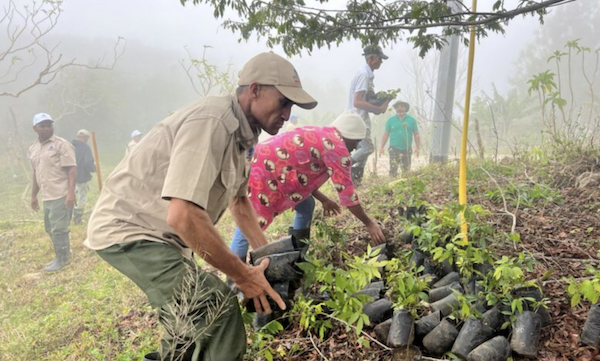
A collaborative environmental initiative led by AVSI Dominican Republic and its partner SOH Conservación successfully executed a series of strategic reforestation days on 17, 18, and 20 March 2026. The efforts, coordinated with the Ministry of Environment and the Center for Research and Popular Education (CIEPO), focus on the long-term stabilization of the Lago Enriquillo National Park ecosystem, as reported in Primicias.
The intent is to combat sedimentation and erosion with strategic planting. Brigades planted approximately 6,000 specimens of native and endemic species, including Red Cedar (Cedro Rojo), Ceiba, Guama, and Corazón de Paloma. These activities took place in the communities of Sabana Real (La Descubierta), Majagual (Villa Jaragua), and El Aguacate (Neyba).
Máximo Díaz, project manager for AVSI, explained that the reforestation sites were specifically chosen in high-altitude zones to prevent soil erosion. By stabilizing the soil in these distant areas, the project aims to reduce the runoff and sedimentation that threaten the water quality and depth of Lake Enriquillo.
The timing of the planting is critical, as it coincides with the onset of the March rainy season in the Enriquillo Basin, ensuring a higher survival rate for the saplings.
“Field Schools” for sustainable agriculture
Complementing the physical planting, CIEPO led a series of “Field Schools” throughout March. These workshops provide practical training to over 100 local producers, at least 30% of whom are women, from Villa Jaragua, Los Ríos, Descubierta, Duvergé, and Vengan a Ver.
The training modules focus on soil conservation and efficient water use, agroforestry and organic composting and production of bio-fertilizers to reduce chemical runoff into the protected area.
Nelson Cuevas Medina, executive director of CIEPO, emphasized that these schools are essential for improving the profitability of local farms while simultaneously protecting the park’s buffer zone.
A model of shared responsibility
Jorge Brocca, executive director of SOH Conservación, highlighted the “valuable opportunity” to bridge technical institutional knowledge with the lived experience of rural producers. This sentiment was echoed by Elvin Matos, head of Reforestation for the Bahoruco Environment Office, who noted that involving the community in the selection of species ensures a greater long-term commitment to the trees’ growth and protection.
The project is funded by the Critical Ecosystem Partnership Fund (CEPF), a global program that provides grants to non-governmental organizations to help protect biodiversity hotspots. Lago Enriquillo and Isla Cabritos are recognized as key biodiversity areas (KBAs) due to their unique hypersaline environment and endangered species, such as the Ricord’s Iguana and the American Crocodile.
Read more in Spanish:
Primicias
23 March 2026