

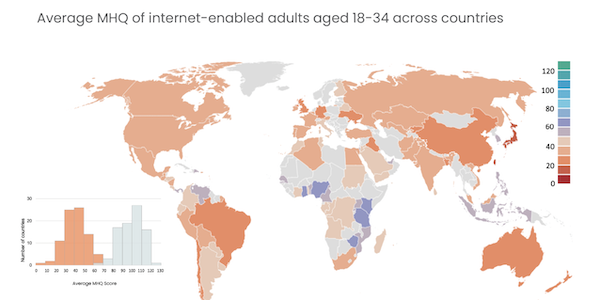
A new study by Sapien Labs (Global Mind Health 2025) has identified the Dominican Republic as the country with the strongest family ties in the world. With a score of 72%, the DR sits 11 points above the global average. The study, which surveyed 1 million people across 80 nations, suggests that these tight-knit social structures act as a “psychological buffer” for Dominicans, particularly among citizens aged 18 to 34, contributing to higher mental resilience compared to other regions.
The Global Mind Health in 2025 Report (formerly the Mental State of the World Report) was released by Sapien Labs on 26 February 2026. This study, which analyzed responses from over 1 million people across 84 countries, highlights the Dominican Republic as a global leader in social and mental resilience.
Based on the 2025 findings and the data sheets released alongside the report, the following sections highlight the Dominican Republic’s unique position:
On family bonds and mental resilience
“The first of these factors [fueling mind health] is weakened family bonds… The MHQ data from 2025 bears this out. Young adults in the Dominican Republic, Argentina and Finland — the countries where the highest percentage of respondents (70% or more) reported close family bonds — had MHQ scores 15 points higher, on average, than young adults in [other studied regions].”
On geographic trends and happiness
“The Dominican Republic continues to lead the rankings for population mental well-being… with its unique blend of cultural richness and a vibrant community, this Caribbean nation emerged as one of the highest-scoring countries in the world according to the survey. The Dominican Republic’s focus on family and strong social relationships provides significant emotional support to its inhabitants, acting as a psychological buffer against the ‘paradox of progress’ seen in wealthier, more technologically-advanced nations.”
On the “Social Self” dimension
“In the dimension of the Social Self—which measures how we see ourselves and how we relate to others—Dominican respondents scored significantly above the global average. This achievement stems from the country’s emphasis on social connections and community support, which play crucial roles in mental health… the combination of a culture that values interpersonal relationships fosters a positive environment conducive to mental wellness.”
Summary of the statistics
• Family closeness: Over 70% of Dominican respondents reported being “very close” to many family members.
• Mental Health Quotient (MHQ): The DR consistently ranks in the top tier (Succeeding/Thriving), often contrasted against wealthier nations like the UK or Japan, where scores have plummeted among younger generations.
• The buffer effect: The report suggests that for Dominicans, family closeness matters twice as much for mental well-being as individual income levels.
Sapien Labs is a non-profit research organization founded in 2016 that studies the human brain and mind. Their primary mission is to understand how our rapidly changing social, technological, and environmental conditions—such as smartphone use, diet, and social isolation—impact mental well-being and brain function.
Sapien Labs was founded by Dr. Tara Thiagarajan, a neuroscientist with a background from Stanford University of California and the United States’ National Institute of Health (NIH). Her goal was to move neuroscience out of the traditional lab setting and into the “real world” to see how different lifestyles and environments change the way our brains function.
The organization’s Global Mind Project is regarded as the world’s largest ongoing study of mental well-being. Sapien Labs is particularly well-known for identifying what they call the “Paradox of Progress.” Their data often shows that mental well-being is declining in the wealthiest, most technologically advanced nations while remaining more resilient in developing countries with strong traditional social structures. Their research focuses heavily on the impact of early smartphone ownership on youth mental health, how ultra-processed foods affect brain health and the critical role of family and community bonds (which is where the Dominican Republic consistently scores high).
Read more:
Sapien Labs Global Mind Health Report 2025
Global Mind Health 2025
Sapien Labs
24 March 2026