

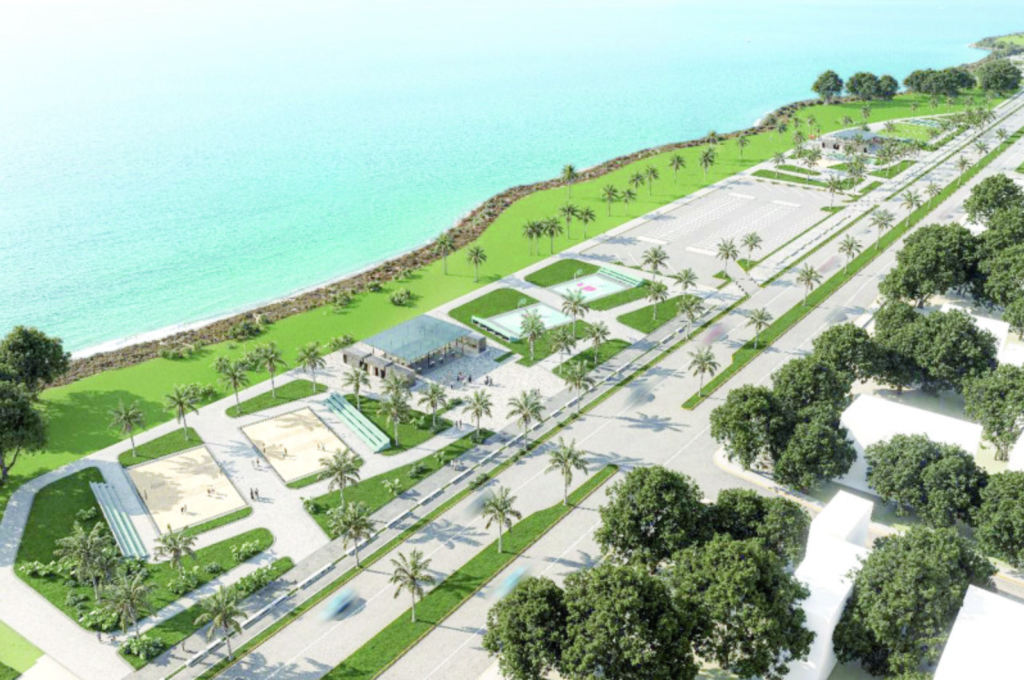
The National District City Council (ADN) is set to inaugurate the Malecón Deportivo tomorrow, a 1.7-kilometer urban intervention designed to pivot the capital’s coastline from a high-speed transit artery into a premier destination for sports, recreation, and family life, Diario Libre reports.
Developed by the ADN in partnership with Right Construction, the project represents an investment of RD$333 million. Spanning approximately 90,000 square meters, the “mega-project” serves as the second phase of a broader coastal recovery initiative that has reclaimed 5.2 kilometers of the coastal boulevard over the last six years.
A hub for modern athletics
The Malecón Deportivo is specifically engineered to meet the growing demand for diverse public sports facilities. Key installations include:
• Soccer & basketball: A closed soccer pitch featuring artificial turf and night lighting, alongside dedicated basketball courts.
• Beach sports: Professional-grade sand courts for beach volleyball.
• Padel & skating: Modern padel courts—reflecting the sport’s surging local popularity—and a specialized skatepark.
• Pedestrian mobility: Wide sidewalks and a linear promenade designed for cycling, skating, and jogging.
Beyond local recreation, the site is positioned as a support venue for the upcoming Central American and Caribbean Games, scheduled from 24 July to 8 August 2026. While not all competitions will be hosted on-site, the infrastructure will serve as a high-profile complementary area for international delegations and tourists.
Family-centric design and amenities
According to Aniana Vásquez, Coordinator of Innovation and Special Projects for the ADN, the project is rooted in the “Parks for All” philosophy. “It is a space for everyone,” Vásquez noted, emphasizing that the design balances high-intensity sports with leisure.
The site features two children’s playgrounds, 20,000 m2 of green areas, and over 300 benches, including the iconic “haraganas” (lounge chairs) that have already become a favorite backdrop for photography. To ensure long-term stays, the ADN has integrated a network of commercial modules for food and beverage vendors, public restrooms, and universal accessibility.
Safety and durability challenges
Transitioning a historically dangerous “expressway” into a human corridor required coordination with the National Institute of Transit and Land Transportation (Intrant), the Ministry of Public Works, and the 911 Emergency System. Measures include enhanced signage, traffic control, and speed reduction strategies to protect pedestrians from the adjacent heavy traffic.
Furthermore, engineers utilized high-resistance materials, specifically treated metals and woods, to withstand the harsh Caribbean salinity and humidity. The area also needs to be able to resist tropical storms and not lose all to even a low-category hurricane.
Economic and social impact
The project completes a 5.2-kilometer coastal circuit when combined with the Paseo Marítimo Malecón, which was inaugurated three years ago. Strategically placed parking for 250 vehicles aims to manage the influx of visitors, which already reaches hundreds of people daily during weekend “soft-opening” phases.
Paseo 30 de Mayo
The Malecon Deportivo is the first of two major park areas that will be inaugurated on the Malecon this year, in time for the Central American and Caribbean Games. A second is the Paseo 30 de Mayo being developed on a 50,000 m2 area previously operated by the Colegio Maharishi and also part of the Plan Integral de Santo Domingo of the city government.
With construction moving at a fast pace, this other park area project is located on the inland side of the highway (Autopista 30 de Mayo), near Kilometer 8 of the Av. Independencia to the north side.
While also a park, the Paseo 30 de Mayo is intended to be a green space and “recreational lung” that connects with the coastal Malecón Deportivo via the integrated plan.
The centerpiece of the Paseo 30 de Mayo is a modern, international-standard skating rink (patinódromo). Unlike the recreational skating areas on the seaside, this facility is designed for professional speed skating competitions.
As of mid-April 2026, the facility is approximately 90% complete, with final track surfacing and specialized technical equipment currently being installed to meet international certification requirements.
Post-games, the track will serve as the permanent home for the national skating federation and community youth programs.
Integrated sports and logistics
Because the Paseo 30 de Mayo is located directly across from the Malecón Deportivo, the two sites will function as a unified “Olympic sub-cluster” during the Central American and Caribbean Games:
• Skateboarding: Competition areas are being finalized to host skateboarding events, a sport seeing significant growth in the region.
• Logistics & parking: The Paseo 30 de Mayo includes a large parking building and surface lots designed to handle the high volume of athletes, technical officials, and spectators expected for the coastal events.
• Connectivity: The Paseo 30 de Mayo encompasses a new pedestrian promenade (rambla) that will connect the two projects, allowing athletes and fans to move safely from the inland competition facilities to the coastal recreational zones without crossing the high-speed traffic of the Autopista 30 de Mayo.
Read more in Spanish:
Diario Libre
22 April 2026