

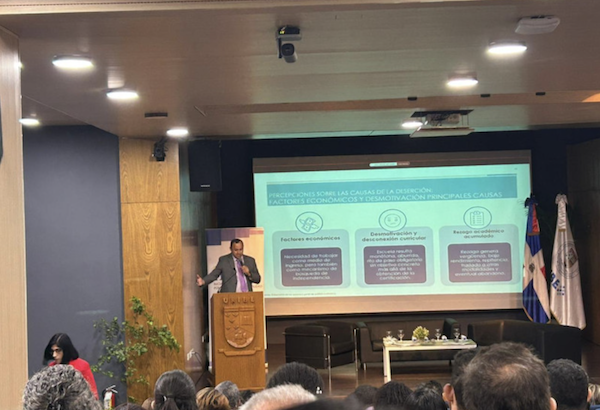
A new report by the Dominican Initiative for Quality Education (IDEC) reveals a sobering reality that more than half of enrolled teenagers drop out of the nation’s public school system.
Analyzing a cohort of 162,000 students from the 2016-2017 and 2018-2019 academic cycles over an eight-year period, researchers found that approximately 52,000 students had been out of the classroom for more than two consecutive years, for a 52.9% dropout rate, as reported in Listin Diario.
The findings, presented to faculty at the Universidad Iberoamericana (Unibe), highlight that the crisis is most acute in urban areas and among specific demographics.
Demographic disparities and geographic hotspots
The IDEC report underscores significant gaps in retention based on nationality and gender. The dropout rate for Haitian nationals stands at 49.7%, nearly 18 percentage points higher than the 32.1% recorded for Dominican students. Gender also plays a decisive role, with 40% of males abandoning their studies compared to 24.8% of females.
Geographically, the municipalities facing the highest levels of educational vulnerability are Mao (47.6% dropout rate), Montecristi (45.9%) and Nagua (44.9%).
The “performative ritual”: Why students leave
IDEC consultant Jerson del Rosario identified a complex web of “drag factors” fueling the exodus. While economic hardship and teenage pregnancy remain traditional reasons, Del Rosario pointed to a growing “disconnection” from the curriculum and a deteriorating school climate.
He described the current state of education as a “performative ritual,” where students focus on completing tasks rather than learning.
“We are finding many high school graduates who are semi-illiterate,” Del Rosario warned. “They lack reading comprehension, writing skills, and a broad intellectual capacity.”
The impact of technology and disinterest
The report suggests that modern technology may be inadvertently facilitating academic stagnation. Del Rosario noted that students often use AI tools like ChatGPT to complete assignments without analysis, allowing them to pass grades without gaining knowledge, a cycle that ultimately leads to total disinterest and eventual departure from the system.
Data shows that 45% of dropouts actually passed their last academic year before leaving, while 55% left mid-cycle. This indicates that academic failure is not the only driver; rather, a lack of dynamic teaching and a sense of “academic rejection” are pushing students away.
Moving toward solutions
The IDEC initiative aims to use this data to refine academic strategies and improve the school environment. By identifying that 45% of surveyed students had experienced at least one episode of leaving school for a full year, the organization hopes to implement earlier interventions to prevent temporary absences from becoming permanent departures.
Read more in Spanish:
Listin Diario
23 April 2026