

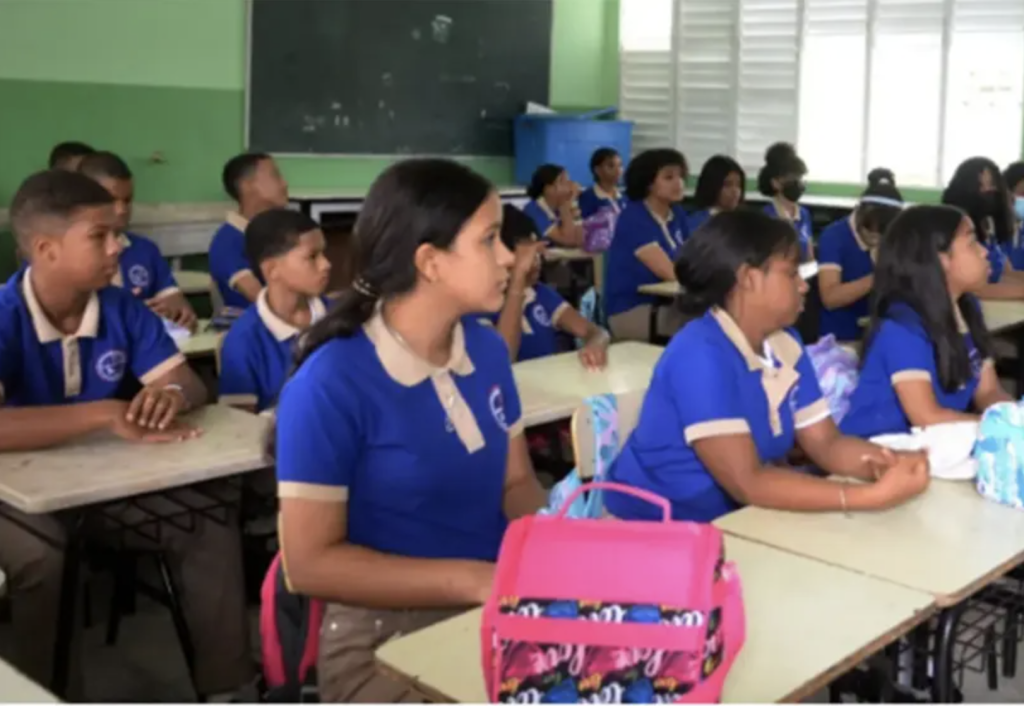
The Abinader administration has issued Decree 309-26, a sweeping mandate aimed at restructuring the Dominican Republic’s educational framework through a “National Consultation for the Future of Dominican Education.” While the government frames the move as a necessary evolution to ensure quality and institutional alignment, the influential Dominican Public School Teachers Union (ADP) has interpreted the decree as a strategic pivot toward favoring the private sector.
The controversy centers on the decree’s linguistic shift. Unlike previous mandates that maintained a rigid distinction between the public and private sectors, Article 4 of Decree 309-26 outlines a “Comprehensive Educational System” without specifying such divisions. This ambiguity has fueled ADP’s claims that the administration is laying the groundwork to redirect state focus—and potentially resources—toward private institutions in a bid to bypass the stagnant results of the public system.
The powerful public teachers union is generally reluctant and ill-prepared to change.
Despite the Dominican Republic allocating 4% of its Gross Domestic Product (GDP) to education since 2012, international and local standardized tests consistently show minimal improvement in student proficiency. Critics and educational analysts frequently attribute these poor outcomes to low teacher competency and the ADP’s long-standing resistance to rigorous performance assessments that would quantify these deficits.
Key mandates of Decree 309-26
The decree establishes an Executive Commission tasked with organizing a nationwide consultation process. According to Article 4, this process is designed to:
Build an integral educational system articulated across all levels and modalities.
Define elements for future-oriented education and reform the national curriculum.
Analyze institutional alternatives to strengthen the system’s legal and organizational structure.
Draft a new Education Law to address contemporary global challenges.
The decree explicitly states that the consultation must be “participative and representative,” involving territorial regions, educational entities, open citizenship forums, and both national and international experts.
Focus on Quality Assurance
Following the consultation, Article 5 of the same decree mandates the creation of specific proposals to bridge the gap between education and the labor market. These include:
National qualifications framework: A tool designed to facilitate educational mobility and professional recognition.
Quality assurance system: The consolidation of national standards to ensure “adequate quality” across all levels of the system.
Research ecosystem: The development of a national educational research body dedicated to generating evidence-based data for the formulation and evaluation of public policy.
The union’s stance
The ADP maintains that the inclusive language regarding “the system” is a Trojan horse for privatization. Union leadership argues that the focus should remain exclusively on the public sector, which serves the majority of the nation’s youth. However, proponents of the decree argue that the “statistically stagnant” performance of public school graduates necessitates a “what people are talking about” approach to reform—one that prioritizes student outcomes over union protectionism.
The abundant resources poured into teacher salaries have impacted private education in the Dominican Republic that since 2012 has lost thousands of their best teachers to the public sector.
The Executive Commission will need to coordinate with the National Commission to maintain some semblance of coherence in the process to unite two ministries, the Ministry of Education and the Minsitry of Higher Education, to respond to current and future needs.
The key players in the new Executive Commission will be the Minister of Education, the Minister of Higher Education, Science, and Technology, the Minister of Public Administration, and the Director General of the National Institute of Professional Technical Training (Infotep).
Read more in Spanish:
Presidency
Decree 309-26
El Nacional
El Dia
El Caribe
11 May 2026