

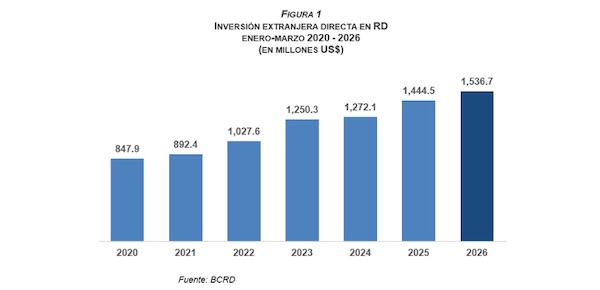
The Central Bank of the Dominican Republic (BCRD) reported that, according to preliminary figures, Foreign Direct Investment (FDI) reached around US$1.54 billion at the close of the first quarter of 2026. This represents an increase of US$92.2 million, or 6.4%, compared to the same period in 2025. The robust performance underscores the nation’s continued appeal to international stakeholders despite a complex global backdrop.
The institution highlighted that around US$1.05 billion, representing more than two-thirds of the total inflows, consisted of new capital contributions. These figures suggest a high level of investor confidence in the long-term prospects of the Dominican economy.
Resilience amid global volatility
These flows reflect the resilience of the Dominican Republic in attracting FDI, notwithstanding geopolitical tensions and fragmentation trends noted by the United Nations Conference on Trade and Development (UNCTAD) in its latest Global Investment Trends Monitor.
The BCRD attributes these steady inflows to solid domestic fundamentals, including sustained social peace, economic and political stability, legal certainty and fiscal incentives, modern infrastructure and advanced telecommunications and proactive government support for foreign investment.
Sectoral distribution: tourism and energy lead
Data from the BCRD shows that half of the FDI inflows were directed toward the tourism (22.5%) and energy (22.2%) sectors, which remain the primary drivers of investment. The energy sector’s prominence highlights ongoing efforts to diversify and modernize the national power grid.
Mining contributed 17.8%, mainly supported by favorable international commodity prices. Likewise, the real estate sector was dynamic, attributed to the expansion of the tourism industry.
Looking ahead, FDI flows for the full year 2026 are projected to reach approximately US$5.20 billion, despite the downward risks identified by UNCTAD.
Strong external sector performance
Beyond FDI, other external sector variables showed favorable performance between January and March 2026:
• Total exports reached US$4.19 billion, a 17.5% increase over Q1 2025.
• Gold exports surged to US$738.1 million, an increase of US$352.5 million (91.4%), driven by production improvements and historic price levels in international markets.
• Free zones: Exports were around US$2.08 million, growing 4.6% year-on-year.
• Remittances: Recorded a 1.9% increase during the period.
Tourism and currency stability
Tourism revenues for the first quarter of 2026 totaled US$3.91 billion, an increase of US$656.0 million (20.2%) compared to the previous year. This growth was fueled by visitor arrivals exceeding 3.35 million during the quarter.
Collectively, foreign currency generated by FDI, remittances, tourism, and exports exceeded US$13.40 billion in the first three months of the year—an increase of approximately US$1.40 billion over the same period in 2025. This substantial influx of hard currency has been a critical factor in contributing to the relative stability of the exchange rate.
Read more in Spanish:
Central Bank
12 May 2026