

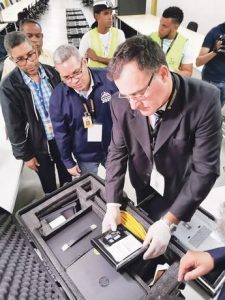
The Central Electoral Board (JCE) and the Organization of American States (OAS) signed an agreement for the audit of the automated voting process used in the aborted municipal elections of 16 February 2020. JCE president Julio César Castaños Guzmán and OAS Secretary-General Luis Almagro signed the agreement on Monday, 2 March 2020 at the JCE headquarters in Santo Domingo.
After the canceling of the municipal election on 16 February, a presidential commission made up by Presidency Minister Gustavo Montalvo, legal advisor to the President Flavio Darío Espinal (a former ambassador of the Dominican Republic to the OAS) and Dominican ambassador to the OAS Josué Fiallo met with Almagro in Washington D.C. to request the audit of OAS to determine the reasons for the e-voting glitch. Almagro is up for reelection by the Permanent Council on 20 March 2020.
On Sunday, 1 March 2020, the deputy director of Information Technology of the JCE, Johnny Rivera, explained that 80 machines will be audited. Of these, 20 are devices that never presented any problems, 20 showed faults and were never repaired, another 20 were defective at first but finally worked, and another 20 were backup machines.
In signing the agreement with the Central Electoral Board (JCE), Almagro said the OAS technicians seek to identify why the system did not operate properly. “The auditors will begin their work this week and will work with due care so as not to hinder the work of the technicians and officials dedicated to the organization of the extraordinary municipal elections,” he said. The JCE has rescheduled the municipal election for 15 March 2020, this time using paper ballots.
Almagro spoke of the importance of strengthening the electoral process on for 15 March 15, the commitment of all Dominicans so that these elections are fair and transparent.
The OAS is entrusted with the audit at a time when social media abuzz around the controversy surrounds the OAS participation in the Bolivian election. Massachusetts Institute of Technology (MIT) researchers commissioned for an independent study by a group called the Center for Economic and Policy Research found that the OAS had misled the media and public about what happened in the recent Bolivian presidential election. The New York Times describes the group as one that “has been supportive of left-leaning governments in South America.” The OAS is set to monitor new national elections in Bolivia set for 3 May. Former Bolivian President Evo Morales, still in exile, has effectively been barred from running. Morales is in exile in Argentina. His favored candidate is leading in the polls.
The United States finances around 60% of the OAS budget.
Read more:
Listin Diario
Common Dreams
NYTimes
Washington Post
CNS News
3 March 2020