

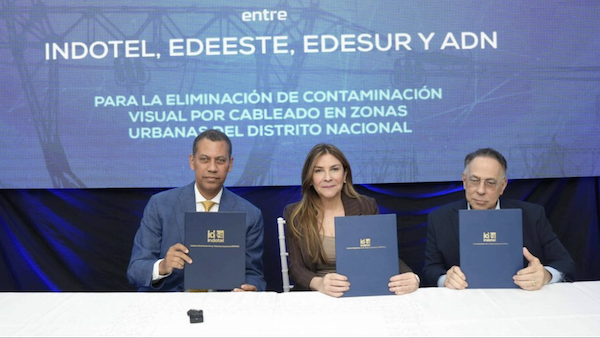
In a coordinated effort to improve public safety and urban aesthetics, the Dominican Telecommunications Institute (Indotel), the Mayor’s Office of the National District (ADN), and the Unified Council of Electricity Distribution Companies (CUED) signed a strategic cooperation agreement on Thursday, 26 February 2026, to remove obsolete and unused aerial cabling across the capital, as reported in Diario Libre.
The agreement was formalized by Guido Gómez Mazara, president of Indotel; Celso Marranzini, president of the CUED; and Carolina Mejía, Mayor of the National District. The initiative targets the “visual pollution” caused by tangled wires and aims to mitigate physical risks to pedestrians and drivers caused by deteriorating infrastructure.
In recent years, residents of Santo Domingo have frequently reported “spaghetti” wiring falling into streets, posing electrocution hazards and obstructing sidewalks.
Strategic execution and priority zones
The project is set to impact over 300 kilometers of cabling, spanning both high-traffic commercial corridors and residential neighborhoods. The removal will be carried out in stages, prioritizing the following areas:
• The Ciudad Colonial and San Carlos
• The Polígono Central (including Naco, Piantini, and Bella Vista)
• Populous sectors such as Cristo Rey and Los Girasoles
Guido Gómez Mazara described the pact as a “turning point” for the city, moving from years of planning into a concrete execution phase. “Removing obsolete cabling is not just an aesthetic choice; it is a direct responsibility toward citizen safety and urban mobility,” Gomez Mazara stated during the signing at the CUED headquarters.
Institutional roles
Each entity has been assigned specific mandates to ensure the project’s success:
• Indotel: Will serve as the regulatory lead, coordinating with telecommunications providers to ensure networks are organized without interrupting essential services.
• ADN (Mayor’s Office): Responsible for field supervision, logistics, and the final cleaning of intervened areas to ensure the public space is fully recovered.
• CUED: Will provide technical support to distinguish between telecommunications wires and active electrical lines, ensuring the safety of workers during the removal process. The CUED oversees the country’s three main distributors: Edeeste, Edenorte, and Edesur.
Mayor Carolina Mejía emphasized that the cleanup is a priority for the wellbeing of the capital’s inhabitants.
Read more in Spanish:
Diario Libre
3 March 2026