

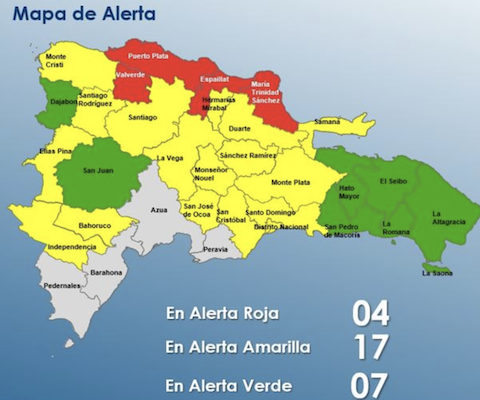
After the torrential rains that fell since the early start of Wednesday, 8 April 2026, caught people in Greater Santo Domingo by surprise, Indomet director Gloria Ceballos personally warned everyone more rains were on the way for the weekend. Last Wednesday, 8 April 2026, heavy rains associated with a trough and a frontal system resulted in at least one fatality in western Santo Domingo and the displacement of thousands. The city had been under a green alert.
Weather office director Ceballos this time around alerted people in Greater Santo Domingo (National District and Santo Domingo province) to prepare for more rains over the weekend. Greater Santo Domingo was under a yellow alert given by the Center for Emergency Operations (COE). The Indomet director explained that the atmospheric instability is caused by a combination of a frontal system and a trough (vaguada) lingering over the region.
But the rains did not flood Greater Santo Domingo this time. The rain threatened all throughout the weekend, but the Chayenne concert at the Quisqueya Park and the Santo Domingo Swimming Open all were able to be held. The rains didn’t fall until the late evening of Sunday, 12 April 2026, and they were consistent but light this time.
Puerto Plata and Montecristi instead were hit hard. Puerto Plata had been included in the notifications and indeed got a red alert for the weekend. As of the start of the week, Puerto Plata continues under yellow alert.
The lack of precision in weather forecasting reveals the lack of adequate training of the local weather forecasters in the data now available through the country’s brand new radars located at the Las Americas International (SDQ), Punta Cana International (PUJ) airports and at the Isabel de Torres Mountain in Puerto Plata. Meteorologist based in Puerto Rico, Rafael Mendez told CDN that the problem is the lack of training of the local forecasters in the new systems. He says this limits their capacity to analyze the data. The radars provide precision data in real time enabling people to be alerted as to which areas will be most impacted by rain.
To not be caught off guard, this time President Luis Abinader headed a meeting at the Presidential Palace at the start of the weekend and cautioned the population to stay away from rivers and streams and to cooperate with authorities during evacuations of persons in vulnerable areas. At the meeting, President Abinader declared a permanent session to monitor the weather situation and its impacts.
President Abinader mentioned that no drainage systems were capable of handling nearly 16 inches (400 mm) of rain in a short period of time. An article in the ElCaribe newspaper explains that when rains fall hour after hour, the city’s runoff system is overwhelmed. The problem is not the rains, but rather the city’s infrastructure that was not designed for the current climate systems, nor for the incredible urban expansion the city has undergone. Where there were patios that drained the water, there is now 30-apartment high rises.
President Abinader would eventually declare a state of emergency in Decree 234-26 for five provinces (Puerto Plata, Espaillat, Valverde, Santiago, Santo Domingo and the National District (Greater Santo Domingo) on Sunday, 13 April 2026. Indomet forecasts another trough will bring more rains this week and these areas are recovering from past heavy rainfall. The Center for Emergency Operations lists 26 of 32 provinces under weather alerts. Only provinces not on a weather alert of 12 April are Azua, Peravia, Barahona and Pedernales. Dajabon and San Juan de la Maguana are under green alert.
The Ministry of Education called off classes in provinces under yellow alert and instructed public employees to telework when possible.
The El Caribe article quotes meteorologist Jean Suriel who concurs that no city is prepared to channel so much rain in such a short time. Santo Domingo’s drainage system was constructed 40 or 50 years ago, under different climatic parameters, when the rains were less intense and more evenly distributed. The changes were presented in a graph that showed rains going from 10 mm per hour in 1980, to 50 mm per hour in 2026. And there is another factor, much more human: garbage. Many of the storm drains are choked with refuse, causing rapid flooding of streets and tunnels.
In Santiago, Mayor Ulises Rodriguez got AI to work and create a campaign to urge people to become aware of how the correct disposal of plastic and other wastes can reduce the urban flooding. The plastic wastes are thrown in gullies and streams and when it rains heavily, these overflow, clogged by the garbage.
Read more:
El Dia
Listin Diario
Listin Diario
Presidency
El Caribe
CDN
N Digital
N Digital
N Digital
N Digital
N Digital
Listin Diario
Listin Diario
Listin Diario
Listin Diario
Listin Diario
Diario Libre
Diario Libre
Diario Libre
DR1 News
13 April 2026